The American Society of International Law Cultural Heritage and the Arts Interest Group has published its second issue. Topics include the Machu Picchu artifacts which appear to be returning to Yale; the Met’s repatriation of objects from King Tut’s tomb, California’s new Art Law, and more. You can find subscription information here.
Footnotes
- Boy George (yes that one) agreed to return a looted icon to Cyprus after the church community saw the icon in a TV interview.
- Switzerland’s Federal Culture Office is calling for a simplified and more accessible provenance research process, particularly with respect to Nazi-era spoliation.
- Three works—a Samuel Peploe, Jean-Baptiste-Camille Corot, and Federico Barocci—were missing after an audit of the Glasgow Museums collection. They have been recovered after a curator saw the Corot listed in a catalog.
- The United Kingdom’s Culture Minister Ed Vaizey announced yesterday that this work has been denied export temporarily, in the hopes a domestic buyer will purchase the work.
- Rutgers University’s Zimmerli Art Museum has voluntarily agreed to return a work confiscated by the Nazi’s to the grandson of the original owner.
- Plans to draw tourists to the Roman city of Jerash in Jordan.
- Tip of the iceberg: the British Museum kept 99% of its collection in storage during 2009-10 (via).
- The import restrictions on certain objects from Italy have been announced. Let the rational appraisal begin.
![]() |
| “Portrait of a Young Woman” perhaps by Peter Paul Rubens |
What’s the Difference Between a Pawnshop and antique shop?
Given that kind of violence, a sensible increase in regulation seems warranted. It seems as if a running catalog of objects sold would be very helpful. Fingerprinting may be a step too far, but a simple photocopy of a drivers license perhaps would not seem out of the qustion, particularly if an objects value exceeds a sensible amount, $5,000 perhaps.
Meanwhile, European pawnbroking began to flourish during the Middle Ages. The Norman Conquest introduced the practice to England, and the Lombardy region of northern Italy was another hotbed of pawnbroking. In fact, pawnbroking became so strongly identified with Lombardy throughout Europe that the term “Lombard” gradually became synonymous with “pawn shop” and “Lombard banking” was a widespread term for pawnbroking.
Anyone who turns to a pawnbroker to scare up some quick cash is in good historical company. Pope Leo X, a notoriously free spender, once had to pawn his own palace furniture and silver to cover his luxurious lifestyle and patronage of the arts. (It’s no surprise, then, that Leo X was at the helm of the Church when it gave the practice of pawnbroking the official thumbs-up in 1515.) In 1338 King Edward III hocked his jewels to raise funds for the English military at the dawn of what would become the Hundred Years’ War.
- Derek P. Jensen, Utah’s used-book, antique shops fear crackdown, The Salt Lake Tribune, January 13, 2011, http://www.sltrib.com/sltrib/home/51045760-76/says-law-antique-lawmakers.html.csp (last visited Jan 18, 2011).
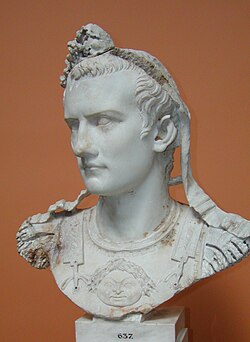
Looted Statute (maybe Caligula) Seized Near Rome
| A Bust of Caligula at the Ny Carlsberg Glyptotek |
Italian police have arrested a tombarolo with an 8-foot ancient statue not far from Rome. The statue may be worth €1 million. They believe the statue may be of Caligula, and may even have been looted from Caligula’s tomb, which has not been discovered. We surely won’t know if this tomb or the site was the actual tomb, but if looting is destroying the archaeological record, we are losing information.
Might the record have given us information on Caligula, who may have received a bad rap from the sources which have survived antiquity? Contemporaries describe the emperor as insane, saying he appointed a horse as consul, slept with his sisters, and killed often. But these might have been claims made by his political enemies in the senate and elsewhere—perhaps not too different from today’s politics. After all, how could the son of Germanicus (my favorite Roman) have been such a bad guy. Caligula only ruled from AD 37-41, before he was assassinated.
I wonder where this statue was going to be sold? The United States, the middle-East, Asia? Excavations will start to reveal the archaeology of the site where the tomb raider unearthed the massive statue.
- Tom Kington, Caligula’s tomb found after police arrest man trying to smuggle statue, The Guardian, January 17, 2011, http://www.guardian.co.uk/world/2011/jan/17/caligula-tomb-found-police-statue (last visited Jan 18, 2011).
An Interview with Paolo Giorgio Ferri
Fabio Isman had a terrific interview with Italian Prosecutor Paolo Giorgio Ferri which I’ve just now gotten around to reading. Ferri was the prosecutor during Marion True’s trial in Italy. The discussion ranged from the problem of prosecuting antiquities looting to the international laws which apply, and the damage done by metal detecting. Here is an excerpt:
GDA: What was your first investigation into illegal excavations?
PGF: It was in 1994, with the then sergeant of the carabinieri department for cultural heritage, Vito Barra, now in charge of security at the Vatican Museums. We believed that a statue stolen at Villa Torlonia had been put up for auction at Sotheby’s. So we travelled to London [but made no progress]. Five months later, Sotheby’s sent me the names of two companies: Edition Services and Xoilan Trading. Edition Services is a company owned by Giacomo Medici, until now the only important “art robber” to have been convicted in Italy [Medici is currently appealing]. Xoilan Trading is one of the various names of [companies connected to] the art dealer Robin Symes. But at the time we didn’t know this. Faced with two Panamanian companies, Barra was on the verge of giving up. “No one’s going to tell us anything,” he said. Shortly afterwards, I met Daniela Rizzo, an archaeologist of the monuments office for southern Etruria. Together with Maurizio Pellegrini, from the museum of Villa Giulia, she was to play a crucial role in my work.
- Fabio Isman, “Clandestine excavation is a crime that is hard to prove”, The Art Newspaper, January, 2011, http://www.theartnewspaper.com/articles/%E2%80%9CClandestine+excavation+is+a+crime+that+is+hard+to+prove%E2%80%9D/22164 (last visited Jan 18, 2011).
Friday Diversion: Eating in Amelia
I’m receiving a handful of questions each day from folks interested in attending the MA program in Amelia this summer. One of the most common kinds of questions seeks information about the day-to-day during those three months of the program. For those folks, I strongly recommend a look at Catherine Sezgin’s recent series of posts on Amelia. Catherine graduated with the MA Certificate in 2009, and has gone on to do some super writing and research and in her spare time maintains ARCA’s Blog. Have a look:
We have a really strong pool of applicants so far, but there is still space for more, so I do encourage you to submit an application, the deadline is January 21st.
Eating in Amelia
One of my favorite things to think about. I’m receiving a handful of questions each day for folks interested in attending the MA program in Amelia this summer. One of the most common questions ask about the day-to-day during those three months. We have a really strong pool of applicants so far, but there is still space for more, so I do encourage you to submit an application, the deadline is January 21st. In the meantime on a Friday afternoon, I recommend Catherine Sezgin’s series of posts on Amelia. Catherine graduated with the MA Certificate in 2009, and has gone on to do some super writing and research and in her spare time maintains ARCA’s Blog. Have a look
Wild Story of A Forger who Donates his Forgeries
Randy Kennedy has a super article (following an earlier report in the Art Newspaper) discussing a man named Mark Landis who forges works of art and donates the forgeries to art museums all over America. He may have been doing this for as many as twenty years.
His real name is Mark A. Landis, and he is a lifelong painter and former gallery owner. But when he paid a visit to the Paul and Lulu Hilliard University Art Museum in Lafayette, La., last September, he seemed more like a character sprung from a Southern Gothic novel.
He arrived in a big red Cadillac and introduced himself as Father Arthur Scott. Mark Tullos Jr., the museum’s director, remembers that he was dressed “in black slacks, a black jacket, a black shirt with the clerical collar and he was wearing a Jesuit pin on his lapel.” Partly because he was a man of the cloth and partly because he was bearing a generous gift — a small painting by the American Impressionist Charles Courtney Curran, which he said he wanted to donate in memory of his mother, a Lafayette native — it was difficult not to take him at his word, Mr. Tullos said.
That is a pretty remarkable thing to do, even in the art trade. The lesson is clear though, we can certainly blame the forger/donor, but provenance and the history of an object must be checked, even when an object is donated.
- Randy Kennedy, Elusive Forger, Giving but Never Stealing, N.Y. Times (Jan. 12, 2011).
- Helen Stoilas, “Jesuit priest” donates fraudulent works, The Art Newspaper (Nov. 2010).
The Central Park Obelisk
![]() |
| The Obelisk in Central Park |
On January 4th, Zahi Hawass posted on his blog parts of a letter he sent to New York City May Bloomberg which was erected in Central Park in 1880. Hawass was not criticizing the installation of the monument, or the way in which Frederick Olmstead installed it in his grand park. Rather Hawass voiced some concerns about weathering being done to the hieroglyphic text on the needle. News of the fact that New York is not caring for an ancient Egyptian obelisk soon spread. David Gill argued “Noth Americans” who are critical of the situation at Pompeii should be “chastened”. But I’m not at all sure that weathering is actually taking place, and I do not see how Zahi Hawass can make that claim either: he has made his allegations on the basis of some photographs which he was sent.
It seems to me that Hawass is instead trying to argue that wealthier nations are not caring for antiquities, and arguing that he and Egypt will. He says that “If the Central Park Conservancy and the City of New York cannot properly care for this obelisk, I will take the necessary steps to bring this precious artifact home and save it from ruin.”
No one can fault Hawass for his passion, but here I think his criticism of the care for this obelisk is misguided. Is there something toxic about New York that is prematurely weathering this obelisk? What about the similar obelisks in London and Paris?
Weber on Liability for Faked or Wrongly Attributed Works of Art in the U.S.
Marc Weber, an attorney in Zurich, has passed along his recent book section on certain aspects of U.S. law dealing with fake or wrongly attributed art works. It appears in a volume honoring Kurt Siehr on his 75th birthday, which appears to be worth seeking out as well, with contributions in both English and German. Marc has made the piece available at his website, and I’ve reproduced the introduction below:
A work of art isn’t always what it seems to be. Sometimes the buyer learns that he has just purchased a forgery and sometimes the seller realizes that he has just sold an original. As with other contract dispute, the dissatisfied party will seek redress in the courts, but the courts are faced with problems that are specific to dispute arising from the sale of art when it comes to fakes, the provenance and authenticity of works of art.
If the sold piece of art is a forgery, the buyer sues for the repayment of the purchase price in exchange for the return of the work of art. The buyer will seek to do the same after having bought a work of art which is not executed by the artist but by his school. The seller attempts to sue the buyer for the return of the work of art in exchange for the restitution of the purchase price, should a work of art sold as a real copy turn out to be the work of the master or a painting from a school is actually a work of the master himself. The legal remedies of the first case (warranty) differ from the ones of the second case (mistake).
In addition to the remedy of rescission of the contract, under certain circumstances, a cause of action for product disparagement may arise. Finally, if artists’ authentication boards or committees are considered as the only authority to authenticate certain pieces of art, breaches of antitrust laws could be claimed.
It is a concise and very lively summary of the relevant legal rules, with helpful summaries of many of the major cases. It is also a suitable tribute to Prof. Siehr, who I have not had the pleasure of meeting, but who has some outstanding scholarly writings which are well-written, scholarly, and sometimes even funny.