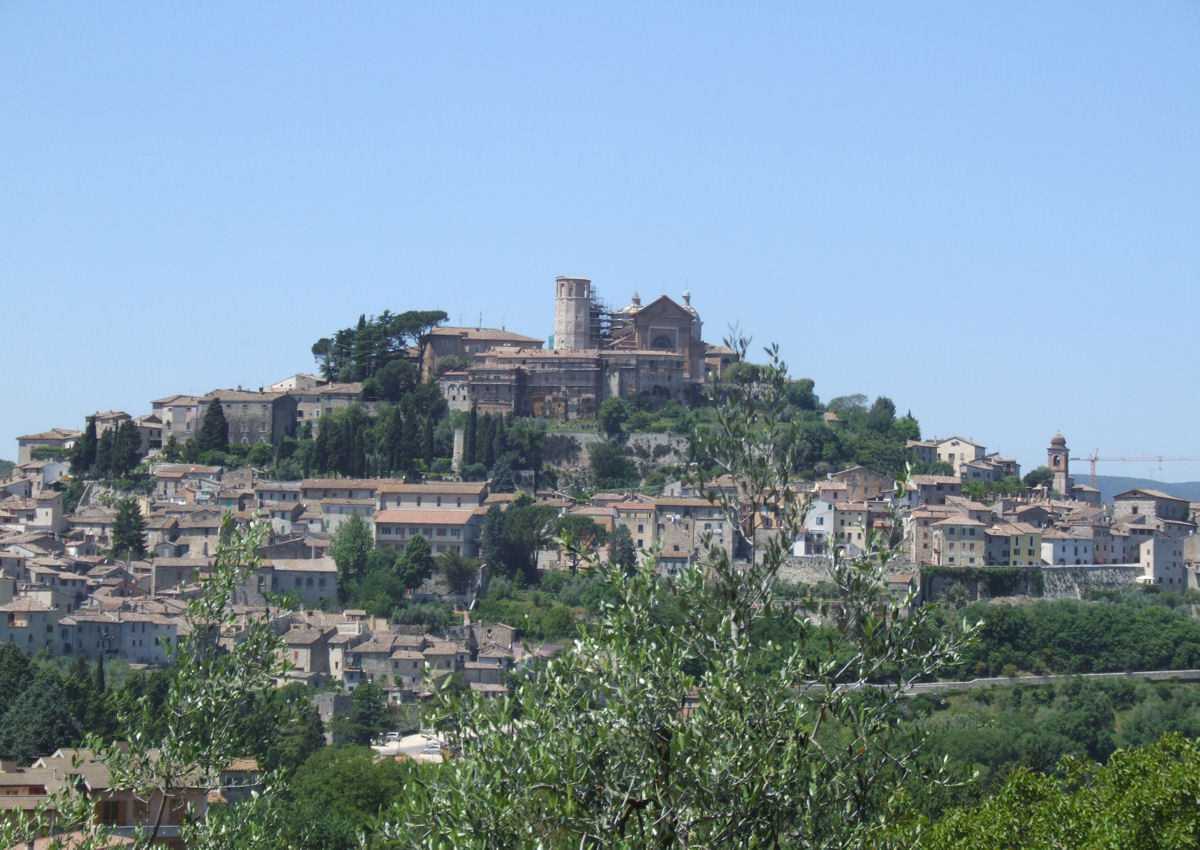
 Posting will likely be light for the next few weeks. I have the great fortune to teach a module of the ARCA Masters program in Amelia for two weeks on antiquities and heritage law.
Questions or Comments? Email me at derek.fincham@gmail.com
art, heritage, & law
Posting will likely be light for the next few weeks. I have the great fortune to teach a module of the ARCA Masters program in Amelia for two weeks on antiquities and heritage law.
 Steven Shrader, one of the 24 individuals indicted for dealing in looted antiquities killed himself Thursday night. This comes after the suicide of another man in connection with the case. The sad news should increase the criticism by two Utah senators who have asked for a Congressional investigation into the tactics used by Federal Authorities.
The Salt Lake Tribune reports:
News of a second death in the antiquities crackdown surprised southeastern Utahns . . . . “That’s tragic — if it’s the result of his concerns over his case,” said Phil Mueller, a Blanding resident and Redd family friend. “I don’t know — I don’t know [Shrader]. But to hear the news is certainly very tragic.” Mueller added that he doesn’t accept federal authorities’ explanation that they needed a show of force in the raid because they believed most of the suspects could be armed. “You could walk up to any house in San Juan County,” he said, “and they’d probably have a gun.”of a second death in the antiquities crackdown surprised southeastern Utahns, although those contacted said they had not heard of Shrader.
On a brisk morning last September, three men — including a federal undercover operative — carried shovels and rakes to an ancient Puebloan mound on public land in San Juan County. As they piled dirt onto a blue plastic tarp, out popped a skull.The discovery, recorded in real time and detailed in recently released federal court papers, didn’t seem to slow the men much.
Richard Bourret picked up the skull and put it back in the hole, the documents say, then he, Vern Crites and the operative, whom federal authorities call the “Source,” folded the tarp and funneled the dirt back into the hole. There wasn’t quite enough to cover the damage.
Crites lamented a lost opportunity, saying he “wished that fella had still been intact, the skeleton, I mean.”
| The Daily Show With Jon Stewart | Mon – Thurs 11p / 10c | |||
| Peter Laufer | ||||
| thedailyshow.com | ||||
|
||||
I saw this interview of Peter Laufer yesterday, and it highlights the similarities between the illicit art and antiquities trade and the trade in endangered species. Laufer here could just as easily be talking about many antiquities collectors, or as Jon Stewart calls them “supervillains”.
Patty Gerstenblith has posted a recent article, Schultz and Barakat: Universal Recognition of National Ownership of Antiquities, which appeared in the recent issue of Art, Antiquity and Law, Vol. 14, No. 1, Apr. 2009. She discusses the two recent cases in the United States and United Kingdom which lay out the requirements for how courts in these two nations view national ownership declarations of art and antiquities by other nations of origin. Here is the abstract:
Two decisions, one in the United Kingdom and one in the United States, decided just about five years apart, are significant for universalising the principle that vesting laws – laws that vest ownership of antiquities in a nation – create ownership rights that are recognized even when such antiquities are removed from their country of discovery and are traded in foreign nations. This basic principle has proven to be very controversial in the United States and has been subjected to bitter criticism; yet virtually the same legal principle, when decided in a British court, received little comment or criticism. Compounding the interest of these two decisions is that, although both decisions came to virtually the identical conclusion, they did so utilizing different methods of analysis.
Although laws regulating cultural heritage have a long history, nations have enacted national ownership laws since the nineteenth century for the dual purposes of preventing unfettered export of antiquities and of protecting archaeological sites in which antiquities are buried. When ownership of an antiquity is vested in a nation, one who removes the antiquity without permission is a thief and the antiquities are stolen property. This enables both punishment of the looter and recovery of possession of the antiquities from subsequent purchasers. By making looted antiquities unmarketable, these laws reduce their economic value. National ownership laws thereby deter the initial theft and the looting of archaeological sites that causes destruction to the historical record and inhibits our ability to reconstruct and understand the human past. While reinforcing these goals, the Schultz and Barakat decisions also bring uniformity to the national treatment of this central legal principle.
 Brendan Borrell has an interesting piece for Scientific American following up on the number of arrests which focused on the theft of Native American objects from the four corners region, which has been described as a massive outdoor museum. Pictured here are the Butler Wash ruins near Blanding.
Two Utah senators, Orrin Hatch and Bob Bennett have both called on Congress to investigate the actions of the federal agents surrounding the arrests, which led to one apparent suicide, the raid of one home for 10 hours, involving 300 agents and a SWAT team.
One of those arrested, Brent Bullock tells Scientific American, “I’m guilty of arrowhead collecting, as is two-thirds of this town.” It seems he:
[T]ried to sell a blanket fragment, fireboard, and stone hoe known as a Tchamahia. In a phone interview, he said that, like Lacy, he was also asked to identify the spot where the items were obtained and he subsequently signed a Letter of Provenance. He says agents later showed up at his house, placed his arrowheads and other artifacts in bags, and photographed them although they did not have permission to seize his or any other artifacts yet. “They ripped this place apart,” he says. “This town is all stirred up.”

In 1970 UNESCO adopted a convention intended to stem the flow of looted antiquities from developing countries to collections in art-importing countries. The majority of art-importing countries, including Britain, Germany, and Japan, refused to join the Convention. Contrary to other art-importing countries, and reversing its own traditionally-liberal policy, the United States accepted the international regulation of antiquities and joined the UNESCO Convention. The article seeks to explain why the United States chose to establish controls on antiquities, to the benefit of foreign countries facing archaeological plunder and to the detriment of the US art market. I argue that the concern of US policymakers about looting abroad resulted from a series of scandals which exposed the involvement of American museums and collectors with looted material. Advocacy efforts of American archaeologists also played a key role in educating policymakers about the loss of historical knowledge caused by looting and the necessity of regulation. The article further analyzes how antiquities dealers and certain museums lobbied Congress against implementing the UNESCO Convention and why Congress decided in favor of implementation as an act of international moral leadership. Following the analysis of the Congressional battle, I examine how the US debate over looted antiquities has evolved to the present. The article concludes with implications for the role of values versus interests in international law.
That’s what Joseph Sisto said to his father with respect to the 3,500 objects in the elder Sisto’s Illinois home according to Rosalind Bentley in a piece in the Atlanta Journal Constitution on Sunday.
These things are three-times cursed, Sisto, of Duluth, would tell his father, John. Cursed once because they were stolen, cursed twice because they were smuggled, and cursed thrice because concealing the cache in their home had robbed the family of its peace of mind.
And there are more details on how the objects came from Italy to the United States. I think one curious thing to pick up on here, are all the crates of antiquities and other objects which were shipped from Italy. Customs agents in both the United States and Italy were unable to detect these objects which were certainly illegally exported, and some were perhaps stolen. I’m left wondering how many crates of objects are still being shipped which are undetected. And I don’t think its a case of authorities not taking this problem seriously, or a lack of legal restrictions; rather I think there are limits to what we can reasonably expect of law enforcement and customs agents.
Collectibles and old texts fascinated the elder Sisto. By the time Joseph was an adolescent, his father was taking him on regular trips to Italy to visit family. The trips were often more drudgery for Joseph than pleasure. Italian summers were interminably hot, and Joseph and his dad would spend hours looking for rare books and manuscripts in musty old castles and homes in the country. Often, his father would either leave with purchased packages or he’d wind up buying the entire contents of the place.
Months after the Italian visits, crates would arrive at the brick bungalow in Berwyn. Scores of crates, almost never just one or two. That’s when the real work began. Joseph, his younger brother and his father would spend every minute of their spare time unloading dirty, messy crates. Instead of playing softball outside with friends or just hanging out, Joseph and his brother had to stay inside and catalogue the contents. But instead of selling the items on the black market (which the FBI said had been part of an original plan), John Sisto kept almost everything.
He converted the second floor of the bungalow into a veritable archive. He had dozens of bookshelves installed. He filled the attic. Then he learned how to read and translate Latin to better appreciate what was in his trove. He quietly and cautiously sought out curators to learn how to properly preserve ancient documents, always taking his absolute worst and most insignificant piece for the consultation so as not to arouse suspicion, Sisto said.

Greek Culture Minister Antonis Samaras has said his nation is not interested in working out a loan arrangement for the Parthenon Marbles.
I can certainly understand that point of view, but at some point don’t we need to move beyond the question of whether that taking in 1801-2 was wrongful; and start asking what is best for the marbles and those who want to learn from them today? I don’t want to belabor the point, but isn’t the fact that the marbles are still on display at the British Museum a pretty strong indication that their removal was legal, or if not, not subject to current judicial scrutiny? We can argue about whether their continued display in London is ethical, but not I do not think a legal question any longer.
From the BBC:
The government, as any other Greek government would have done in its place, is obliged to turn down the offer,” Mr Samaras said, in a statement.“This is because accepting it would legalise the snatching of the Marbles and the monument’s carving-up 207 years ago.”He added that he was prepared to discuss lending Greek antiquities to the British Museum “to fill the gap left when the (Parthenon) Marbles finally return to the place they belong”.Mr Samaras was responding to comments made by British Museum spokeswoman, Hannah Boulton, on Greek radio.She said under existing British Museum policy the museum would consider loan requests by any foreign government, including Greece.But all requests would be considered on a case-to-case basis, taking many factors into consideration, including fitness of the item or items to travel.Greece would also have to recognise the museum’s ownership rights to the sculptures, which is a loan condition.
Ms Boulton told the BBC that the British Museum had not received a request from Greece, nor had it offered the marbles for loan.
 All things considered today has a terrific interview with Joseph Sisto, the son of John Sisto—the man whose private collection of antiquities, books and documents was subject to an FBI investigation resulting in 1,600 objects being returned to Italy. As I wrote earlier this week, this was a staggering number of objects in the hands of one private collection. And clearly the decision by the son to bring in the authorities after his father’s death has created some tension in the family.
As the younger Sisto says in the piece “Throughout the late 1960s and early ’70s, he went back and forth buying estates and castles — the contents of those estates — in Italy, and then shipping them back here to the United States,” he remembers that “[a]t some point, you could barely move in the house.” It seems the elder Sisto was self-taught, teaching himself ancient Latin and script Latin.
The younger Sisto soon realized that many of these objects had been illegally removed from Italy when he learned about the UNESCO Convention, and cultural property law while earning a degree in cultural anthropology.
The story presents a sharp contrast I think, in the attitudes of th elder Sisto who clearly thought he was conducting good research, translating thousands of these ancient documents. However his work, and his collection of objects must surely have violated Italian law. But why was nobody missing all of these documents? Were they really stolen, or instead purchased and illegally exported? What will happen to these ancient documents. I expect historians an dothers will be able to make great use of these documents, something that I don’t think they could have done had the documents remained in private hands.

So argues former First-Lady of Peru Eliane Karp-Toledo in an Op-Ed today in the Miami Herald (for a brief discussion of another Op-Ed in the NY Times, see here). She discusses the ongoing dispute between Yale and Peru over objects taken from Peru by Hiram Bingham, and effectively communicates Peru’s position—and only their position. Though I think it is reasonable to criticize some of the actions of Yale University since they have held the objects, Karp-Toledo does her argument a disservice I think by ignoring some very real and well-founded differences of opinion between Yale and Peru.
For example, she argues “Many years of frustrated negotiations, and Yale’s presentation of an insensitive ‘Memorandum of Understanding’ in 2007, finally led the Republic of Peru to file a lawsuit against Yale in the District Court for Washington, D.C., in December 2008.” Yet I’m not really sure how that memorandum was “insensitive”; nor does Karp-Toledo really tell us why. That agreement, now apparently abandoned, aimed at creating a kind of lease which would have created a collaborative relationship between Yale and Peru. It would have been similar in form perhaps to the agreements Italy has been promulgating with many institutions forced to return looted antiquities. Peru would have received title to all the objects, with many remaining in Connecticut. There would have been an international traveling exhibition, and proceeds would help build a much-needed new museum and research center in Cuzco. Yale also would have provided funds to establish a scholarly exchange program. As Yale president Richard C. Levin said at the time, “We aim to create a new model for resolving competing interests in cultural property,… This can best be achieved by building a collaborative relationship — one which involves scholars and researchers from Yale and Peru — that serves science and human understanding.” I’m afraid I don’t see how this arrangement was “insensitive”.
 Another point of contention is where these objects may be stored if they are returned. Though she points out the Royal Tombs Museum of Sipán (pictured here), she has little to say about the current exhibition near Machu Picchu at Aguas Calientes. An expanded center such as the one Yale had offered would seem to be badly needed, as there are indications the current museum near the Aguas Calientes train station is not fit for purpose, according to Arthur Lubow in a long piece in the NY Times Magazine:
The doors were open to the air, which was moist from the nearby river, and the sole official was a caretaker who sold tickets and then exited the building. On display in the attractive (if unguarded) museum are the finds that Peruvian archaeologists have made at Machu Picchu in the years since Bingham’s excavations.