
On Thursday the New York Appellate Division, First Department handed the Art Institute of Chicago a significant win in its long dispute over Egon Schiele’s Russian War Prisoner. Graham Bowley and Tom Mashberg’s report in the Times frames it as a blow to the Manhattan DA’s investigators. I’d go a step further. This ruling lands on the signature feature of the Antiquities Trafficking Unit’s method, which is that it goes after the objects first and worries about the people later.
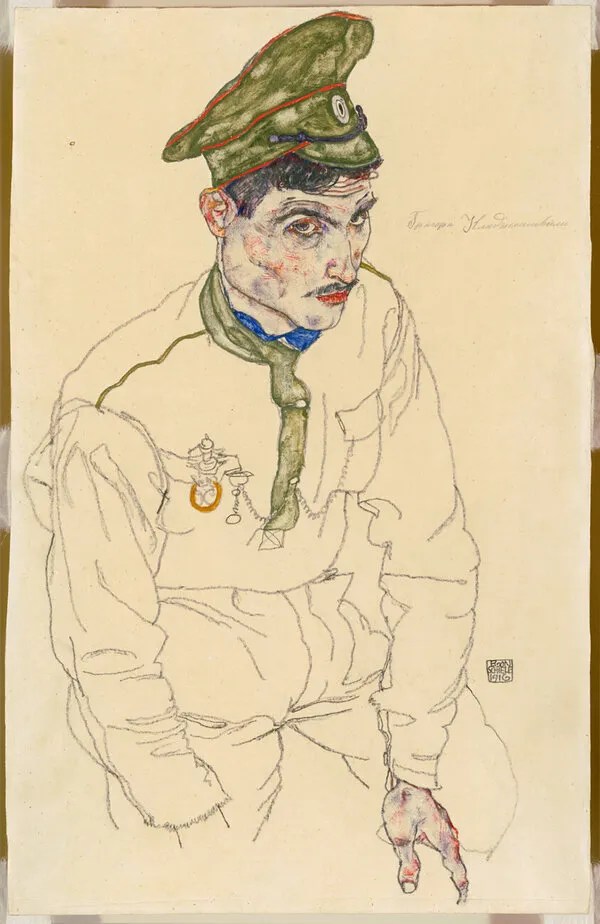
To be precise about what the court did: it did not decide that the Art Institute owns the drawing. It didn’t decide that the drawing was looted, or that it wasn’t. It decided that a turnover order under Penal Law § 450.10 was the wrong tool for a sharply contested ownership dispute. The court vacated the warrant and the orders requiring the museum to surrender the work, and it said in terms that its decision shouldn’t be read as a determination of the rightful owner. It sent the title question to the earlier-filed civil case in federal court in the Southern District of New York.
A quick recap
Fritz Grünbaum was a Viennese cabaret performer and an outspoken critic of the Nazis. He was arrested in March 1938 and died in Dachau in 1941. His collection of dozens of Schiele works was inventoried by the Nazis, and then, for the most part, vanished from the record until 1956, when pieces surfaced with the Swiss dealer Eberhard Kornfeld. Some went on to Otto Kallir’s Galerie St. Etienne in Manhattan, and Russian War Prisoner was ultimately bought by the Art Institute in 1966.
The DA’s Antiquities Trafficking Unit took an interest after Grünbaum’s heirs came to them in 2022. In September 2023 authorities in New York seized the drawing in place at the Art Institute, along with two other works in Pittsburgh and Ohio, on the theory that they were stolen from Jewish families by Nazis. The other two institutions, the Carnegie and Oberlin’s Allen Memorial, returned their Schieles in January 2024. The Art Institute did not, and the museum insisted the work was not looted but lawfully sold by surviving family members after the war.

Meanwhile the heirs’ separate civil suit had been dismissed by Judge Koeltl as time-barred, a ruling he declined to revisit in February 2024. In April 2025, Justice Drysdale sided with the DA. The ruling ran 79 pages and described the drawing as stolen property for the last 86 years. She reached that conclusion without an evidentiary hearing.
Why the appeals court said no
For a first-year-property-class reason, mostly. Section 450.10(5) says stolen property that comes into a court’s custody is to be delivered to the owner “on satisfactory proof of his title.” The Appellate Division reads that as a mechanism for quickly returning property to an obvious owner, not as a way to adjudicate a hotly contested title. The statute doesn’t say who decides title, what procedure applies, or who bears what burden. And the court leaned on a 1913 Court of Appeals decision, People ex rel. Simpson Co. v. Kempner, which said a title dispute between contending parties “must be determined in a civil action,” with notice, a hearing, and a jury if demanded.
The court was also unimpressed by the DA’s description of what happened below as “summary judgment-like.” There were no pleadings, no meaningful discovery, and no defined burdens of proof. And because the turnover orders can’t be appealed directly, the Art Institute could only get review through an Article 78 petition for a writ of prohibition. The court treated a deprivation of property without due process as the kind of clear legal right that makes that extraordinary remedy appropriate.
The object-first model
Here is what I think matters beyond this one drawing. According to the opinion, the DA told the court that New York County judges have signed more than 100 turnover orders, returning more than 4,000 antiquities and artworks. The NY Times reports how those cases typically end: rather than bring criminal charges and face potentially lengthy cases, investigators negotiate agreements, and the holders usually hand over the objects without contesting that they were stolen.
That is an object-centered model, and it has been enormously productive. In its statement to the Times, the DA’s office pointed to the return of more than 6,000 stolen artifacts. But the same statement cites 18 convictions. I don’t want to be unfair about that comparison, because convictions and objects measure different things. Still, it captures a pattern I wrote about after the Worcester seizure : the objects are returning to where they were taken from, but the prosecution of the individuals responsible has lagged well behind.
The object-first approach worked because it let everyone skip the hard part. A holder who cooperates gets no charge, no trial, and a quiet press release. The office gets the object and a headline. Nobody has to prove that a particular person committed a particular crime, and nobody has to adjudicate title. The Art Institute is, so far as I can tell, the rare possessor to refuse the deal and then follow through on the refusal, all the way to a writ of prohibition. The opinion also notes that the DA brought no criminal charges in connection with the work.
Why Schiele works are so contested
This is the part I think a general audience finds most interesting, and the reasons pile up.
First, the objects are portable and the paper trail is thin. Schiele’s works on paper are small, easy to move, and were easy to lose track of in the mass spoliation of 1938 to 1945. The Nazi inventory of Grünbaum’s property listed 81 Schiele pieces but, as the court notes, did not list Russian War Prisoner by name. Identifying a specific drawing with a specific line in a wartime inventory is a big part of the fight.
Second, there is a gap and a story to fill it. Nothing is documented between 1938 and 1956. Kornfeld filled it by saying he had bought the works from Grünbaum’s sister-in-law, Mathilde Lukacs. The Appellate Division in Reif v. Nagy did not credit that account, and this opinion recites why: no documentation of a transfer, no mention of Lukacs in earlier catalogues, and a claim made decades after the fact. The Art Institute still relies on the Lukacs account, as does the museum’s position that the family lawfully sold the work. That account has worked before: in Bakalar v. Vavra, the heirs lost a case involving a different Grünbaum Schiele on laches grounds, which is a reminder of how much turns on which court you’re in and which doctrine is doing the work.
Third, the money. The Grünbaum heirs sold six Schieles at Christie’s in fall 2023, and four of them collectively fetched $18 million. That helps explain both why heirs pursue these works so persistently and why holders defend them so hard.
Fourth, the New York connection. Kallir’s Manhattan gallery handled a good number of these works after the war. That’s what gives a New York prosecutor a jurisdictional hold on a drawing that sat in Chicago for sixty years, and it is exactly the connection the Art Institute has challenged.
Finally, the Art Institute’s own conduct. The opinion recites that there’s no record of a provenance check in 1966, and that in 2002 a museum intern asked Kornfeld about the work and there is no record the museum ever tried to independently verify his answer. The Second Circuit, when it revived the civil suit in March 2025 in a non-precedential summary order, said the Art Institute isn’t an ordinary non-merchant purchaser but a sophisticated one with expertise in Nazi-looted art. Nothing in this week’s decision undercuts that.
The reaction
The museum welcomed the ruling, telling the NY Times that the court rejected an unlawful attempt to use the criminal process to resolve disputed property rights, and that the matter belongs in civil court. The DA’s office said it is reviewing the decision and evaluating next steps. Two museum groups, the Association of Art Museum Directors and the American Alliance of Museums, had filed a joint brief supporting Chicago.
Nicholas O’Donnell, who represented a family that turned over another artwork in 2024, told the NY Times the decision “sharply reduces the D.A.’s ability to pursue the seizure of cultural property.” As the NY Times summarizes his view, owners accused of holding stolen art could now decline to hand it over unless a criminal case is brought, a crime is proven, and title is fully adjudicated. Raymond Dowd, who represents one of the Grünbaum heirs, sharply criticized the reasoning, comparing the objects to contraband that police can seize the way they seize drugs or drug money. Legal experts told the NY Times it is unlikely that holders who already returned works would try to reopen those seizures.
The ruling doesn’t just slow the DA down. It changes the price of contested cases. Where a holder disputes title, the shortcut is closed, and the office has two choices: bring a criminal case against someone, or send the claimants to civil court. That pushes toward what I’d argue was always the harder and more important work, which is investigating and prosecuting the dealers, middlemen, and facilitators who moved this material.
That work has its own problems. In the Schiele story, the central figures are dead. Kallir died decades ago, and Kornfeld is described in recent reporting as the late dealer. The trial court itself noted that every witness with first-hand knowledge of the wartime events had died. You can’t indict a dead man, and a “continuing conspiracy” theory of the kind the trial court accepted is a long way from a case a prosecutor can try. Proving a crime against a living person means proving what that person knew, and gaps in provenance, however damning they look to us, are not the same thing. So for Nazi-era claims like this one, the civil courts really may be the only place a resolution is possible, which is more or less what the Appellate Division said.
The picture is different for the antiquities trade the unit built its reputation on. There, the dealers, collectors, and trusts are often alive, the records are more recent, and the networks are the story. If the office is now pushed away from the easy object-first seizure, the question is whether it has the appetite and the resources to build cases against people. I hope so. The illicit market runs on the individuals who supply, launder, and buy them.
There is a fair case on the other side, too. Dowd’s point deserves a serious answer: police do seize contraband without a trial, and a museum drawing with a disputed, decades-old chain of title is arguably not the same thing as a looted Cambodian statue. Voluntary returns will also presumably continue. Many holders return works because they don’t want the fight, not because a statute compels them, and nothing in this ruling stops that. And it’s possible that the unit will simply reach for other tools. The DA said only that it is evaluating its next steps.
Procedurally, the Appellate Division stayed enforcement for 30 days, and the grand jury investigation can continue. The action that matters now is in federal court, where the case has been stayed pending this decision. There the parties will have what the Appellate Division said was missing: discovery, defined burdens, and a real fight over the evidence. For the heirs, who have waited nearly two decades, that is at once a setback and a chance to finally litigate the merits.
I’ll be watching for whether the next big move from Manhattan is another seizure, an appeal or something else. And nothing here would prevent the parties from coming to some kind of truce and settling their dispute outside of court.
Many thanks to the reporters who’ve followed this for years, especially Graham Bowley and Tom Mashberg at the Times, and The Art Newspaper.
Sources and further reading
Court decisions
- In re Application for a Search Warrant to Search the Premises Located at the Art Institute of Chicago, Nos. 2025-02524 et al. (N.Y. App. Div. 1st Dep’t Sept. 17, 2026).
- Matter of Art Inst. of Chicago, 2025 NY Slip Op 50617(U) (Sup. Ct. N.Y. County Apr. 23, 2025) (also on Justia)
- Reif v. Art Institute of Chicago, No. 24-809-cv (2d Cir. Mar. 11, 2025) (summary order)
- Reif v. Nagy, 175 A.D.3d 107 (1st Dep’t 2019)
- People ex rel. Simpson Co. v. Kempner, 208 N.Y. 16 (1913)
- Bakalar v. Vavra, 619 F.3d 136 (2d Cir. 2010)
Reporting
- Graham Bowley & Tom Mashberg, Investigators Overstepped in Seizing Work From Museum, Court Rules, N.Y. Times (Sept. 18, 2026)
- Corey Rothauser, Art Institute Wins Appeal In Schiele Nazi-Loot Dispute, Law360 (Sept. 17, 2026) ($)
- Judge orders the Art Institute of Chicago to restitute Nazi-looted Schiele drawing, The Art Newspaper (Apr. 25, 2025)
- Art Institute of Chicago argues Nazi loot claim to its Egon Schiele portrait lacks “a single shred” of evidence, The Art Newspaper (2024)
- Art Institute of Chicago fights for possession of Egon Schiele portrait, The Art Newspaper (Apr. 1, 2024)
- Court Halts Schiele Restitution Order for Art Institute of Chicago—For Now, Artnet News (May 2025)
- New York judge reaffirms Art Institute’s ownership of Schiele artwork, Chicago Sun-Times (Mar. 2024)
- Artwork possibly stolen during Holocaust seized from Art Institute of Chicago, two other museums, CBS/AP (Sept. 2023)
Commentary and analysis
- In Litigation Over Holocaust Victim’s Lost Schiele Artwork, Second Circuit’s Reversal Keeps Claims Alive, Grossman LLP Art Law Blog (Apr. 2025)


