A Whale of a Moral Rights Claim in Dallas

Aerial view of a cityscape featuring tall skyscrapers, a large blue mural on a building, and a parking lot with several parked cars.
Julio Cortez/Associated Press

A large mural depicting dolphins swimming in the ocean, located on the side of a building. The mural showcases a blue water scene with clouds and marine life, set against an urban backdrop with a parking lot filled with cars.
History of the Dallas, Texas Wyland Whaling Wall 82
-Ocean Life
Whaling wall 82
Texas Utilities Building
505 Akard Street Dallas, Texas
Back: 164 Feet Long x 82 Feet High
Side: 50 Feet Long x 78 Feet High
Dedicated April 16, 1999

For nearly three decades, Wyland’s Whaling Wall 82, also known as Ocean Life, covered two sides of a downtown Dallas parking garage at 505 N. Akard Street. Painted in 1999, the mural showed blue whales and other marine life swimming across a landlocked city. Then, ahead of the 2026 World Cup, the whales began to disappear under blue paint.

The plan, apparently, was to replace Wyland’s mural with World Cup-related images. Dallas and North Texas are preparing to host nine matches, more than any other World Cup host city. The problem is what had to be erased to make the gesture possible.

The reporting has been especially grim because the loss seems to have resulted less from one dramatic act of hostility than from a chain of institutional shrugging. Someone identified the wall as a good site. Someone noted that the mural was old. Someone checked whether it was part of the City of Dallas public art collection. It was not. Someone apparently assumed that was enough. And then, as Robert Wilonsky wrote in the Dallas Morning News, “someone said: Here’s a wall you can probably paint over. And because no one else said: No.”

Wyland says he was not consulted before the work was painted over. His lawyers have reportedly issued a cease-and-desist letter invoking the Visual Artists Rights Act, the federal moral rights statute that protects some works of visual art from intentional destruction, distortion, mutilation, or modification. The legal questions will turn on facts that are not yet fully public: whether there was any waiver, what agreements governed the original installation, who controlled the wall, and whether the mural qualifies as a work of recognized stature.

But if public recognition matters, the reaction to the erasure is itself part of the story. A work does not have to be in a city collection to matter to a city.

That distinction is important. Public art is not only the art a city formally owns. It is also the art a public comes to know. A mural can become part of a place even if it sits on private property.

The World Cup angle makes the whole episode sharper. Mega-events arrive wrapped in the language of unity, celebration, legacy, and global connection. They also arrive with deadlines, sponsors, temporary beautification, and a tendency to flatten local meaning into marketable spectacle. Cities are asked to show off for outsiders. Too often, that means clearing away the awkward, faded, beloved, or locally specific thing and replacing it with something smoother.

There is also a wider unease surrounding the U.S. hosting of the World Cup this year. Reports suggest that hotel bookings in many U.S. host cities are softer than expected. AP reported that hotel demand has been lighter than anticipated in most of the eleven U.S. host cities, with operators pointing to international travel concerns, visa delays, high ticket prices, and transit costs. Al Jazeera, citing an AHLA survey, reported that many hotel operators saw bookings below initial forecasts, with visa barriers and geopolitical concerns among the cited reasons.

That matters because the World Cup is supposed to be an invitation. Yet the United States is hosting it at a moment when many people have good reason to ask what kind of invitation is being extended.

Immigration enforcement is part of that anxiety. The federal government has reportedly left open the possibility that ICE activity could occur around World Cup events. And this tournament is arriving after a the brutality of immigration enforcement in which the deaths of Alex Pretti and Renée Nicole Good in Minneapolis became symbols of state violence.

So when Dallas paints over a beloved mural to make room for World Cup imagery, the episode lands in an already uneasy atmosphere. It is not only about marine conservation. It is about the strange promise that a mega-event will showcase local culture while the machinery of preparation helps erase it.

There were obvious alternatives. Caitlin Clark at D Magazine asked the simplest question: why not use a vinyl banner? The World Cup lasts 39 days. The mural had previously been covered by advertising and later re-emerged. A temporary covering would have allowed Dallas to celebrate the tournament without permanently destroying a work that had become part of the city’s visual fabric.

Instead, Dallas now has a legal controversy, an angry artist, national attention, and a half-erased mural. Organizers have said that a portion of Wyland’s mural will be preserved as a tribute. But preserving a remnant after painting over the work is a strange kind of tribute. It is a bit like knocking down a historic building and saving a doorknob.

This story may become an important VARA dispute. It may tell us something about murals, private property, public memory, and the continuing importance of moral rights in the United States. But even before the legal issues are resolved, the cultural lesson is clear enough.

If a city wants to host the world, it should begin by paying attention to what its own people already value. The whales were not just old paint. They were part of Dallas’s public memory. And in trying to manufacture a legacy for a global event, the city may have destroyed one it already had.

Caitlin Clark, The Downtown Dallas Whale Mural Drama, Explained (updated May 18), D Magazine (last visited May 21, 2026).

Dallas Express, Cease-and-Desist Issued As Crews Cover Dallas Landmark Whale Mural For World Cup, Dallas Express (May 20, 2026).

Jesus Jiménez, A Beloved Whale Mural in Dallas Is Painted Over Ahead of the World Cup, The New York Times (May 19, 2026).

Robert Wilonsky, All the Mistakes that Led to the Extinction of Wyland’s Dallas Whale Mural, Dallas Morning News (May 18, 2026).

Jamie Stengle, An Outcry Erupts as a Whale Mural Beloved by Many in Dallas is Replaced with Art for the World Cup, AP News (May 19, 2026).

Urgent Legal Battle: Wyland Fights Dallas Mural Paint-Over, NewsRadio 1080 KRLD (last visited May 21, 2026).

Philip Marcelo, U.S. Hotel Operators Say Promised Boon from Hosting World Cup Hasn’t Materialized Yet, AP News (May 12, 2026).

AFP, Low U.S. Hotel Bookings Paint Grim Hospitality Picture at the World Cup, Al Jazeera (May 6, 2026).

Melissa Hellmann, Eight People Have Died in Dealings with ICE So Far in 2026. These Are Their Stories, The Guardian (Jan. 28, 2026).

Maanvi Singh & agencies, ICE Officer Charged over Shooting of Venezuelan Man in Minnesota, The Guardian (May 18, 2026).

Reuters, Minnesota Officials Charge ICE Agent in Shooting of Venezuelan Immigrant, Reuters (May 18, 2026).

Cemeteries, Crown Jewels, Fakes, and War

Recent cultural heritage events remind me that protection is often weakest before anyone thinks to call it protection. A cemetery becomes “vacant” land. A museum becomes a little too open. A forged provenance becomes plausible enough. A customs rule turns movement into uncertainty. A damaged monument returns to Italy. The dramatic theft still has its place. Crown jewels stolen from the Louvre will always draw attention. But the quieter stories may tell us more about how heritage is actually lost: slowly, administratively, through development pressure, through market incentives that reward thin provenance and quick sales, and sometimes violently, in the gap between what the law promises and what institutions are prepared to do.

Heritage can also disappear through neglect, development, poor records, wishful thinking, legal uncertainty, military force, or a stamp on the back of a painting that looks just plausible enough.

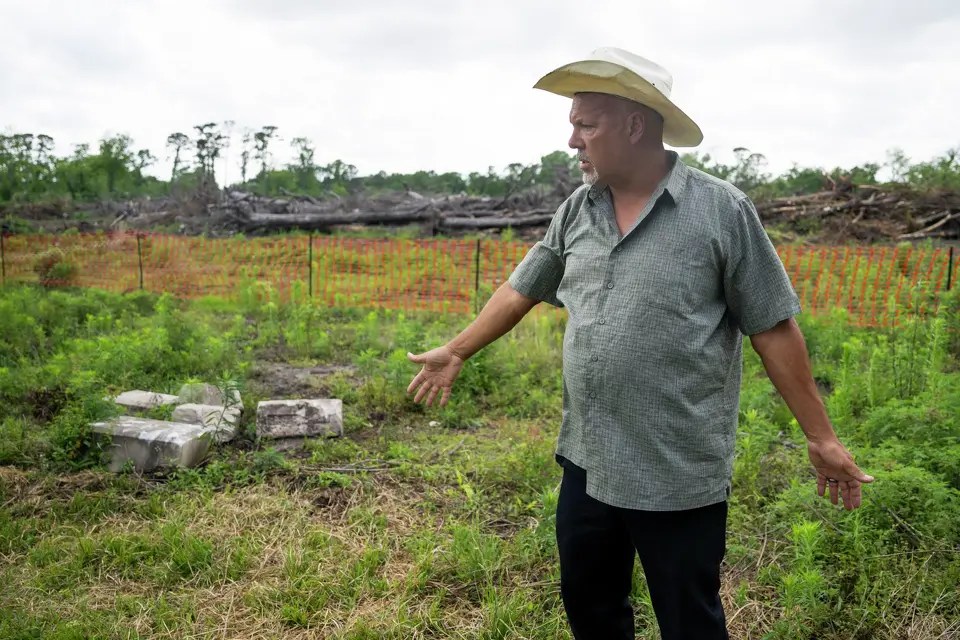
In Northeast Houston, residents are raising concerns that development may threaten an abandoned Black cemetery. The legally recognized cemetery parcel is small, but longtime resident Roscoe Bluitt remembers headstones extending more widely into the wooded land nearby. A 2014 survey reportedly identified possible graves at least partly outside the known cemetery boundaries, and Houston officials have placed a stop-work order on the site while the next steps are considered. Advocates are now calling for a more thorough investigation, potentially including ground-penetrating radar.

Roscoe Bluitt, a lifelong resident of northeast Houston, describes his memories of a now abandoned Black cemetery where developers are clearing a nearby property. Jason Fochtman/Houston Chronicle

The story is painfully familiar. Burial grounds, especially Black cemeteries, are often “forgotten” only after systems of ownership, recordkeeping, maintenance, and development have made them easy to ignore. By the time a neighbor notices bulldozers, the law is already playing catch-up. The question is not simply whether a parcel is listed as a cemetery. It is whether the community, the city, the developer, and the state are willing to ask what may have been missed.

A very different kind of vulnerability is on display in the continuing discussion of museum security after the Louvre crown jewels theft. The New York Times recently used that heist to examine a broader design problem for museums: how to protect collections without turning institutions into fortresses. The article notes not only the Louvre robbery, but also thefts from an off-site storage facility of the Oakland Museum of California, damage at Chihuly Garden and Glass in Seattle, and the recent theft of works by Renoir, Cézanne, and Matisse from the Magnani-Rocca Foundation near Parma.

The challenge is that the museum ideal of openness sits uneasily with the needs of security. Glass, light, gardens, open galleries, and accessible storage can all help museums feel less forbidding. They can also create blind spots, entry points, or tempting routes of escape. The best security seems to be less about a single dramatic barrier and more about layers: thoughtful site design, sightlines, lighting, staffing, cameras, object-level alarms, and best of all the good old-fashioned human response. A camera, as one consultant put it, cannot get out of its chair.

Then there are the fakes. A father and daughter have pleaded guilty in connection with a multimillion-dollar forgery scheme involving works presented as Banksy, Andy Warhol, Andrew Wyeth, Richard Mayhew, Raimonds Staprans, Fritz Scholder, and others. Prosecutors described a scheme using forged works made in Poland, antique paper, and fabricated gallery stamps from defunct galleries to make the objects appear more credible. Forgery stories are often treated as colorful art-world scandals, and they are that. But they also show how fragile the market’s trust mechanisms can be in a market that continues to value privacy and discretion. Provenance is not just a nice story attached to an object.

This photo provided by Tulane University classical archeologist Susann Lusnia in October 2025 shows the 1,900-year-old grave marker of a Roman sailor named Sextus Congenius Verus, discovered in a New Orleans backyard.
This photo provided by Tulane University classical archeologist Susann Lusnia in October 2025 shows the 1,900-year-old grave marker of a Roman sailor named Sextus Congenius Verus, discovered in a New Orleans backyard. (Susann Lusnia via AP)

There was also a quieter and more hopeful story this week. A nearly 2,000-year-old Roman grave marker discovered in a New Orleans backyard has been returned to Italy. The marble epitaph, dedicated to Sextus Congenius Verus, was eventually matched to an object missing from a museum in Civitavecchia, near Rome. The likely path to New Orleans seems to have involved a U.S. soldier who served in Italy and later kept the stone at his home. The FBI coordinated the return, and the object is now headed back.

The movement of objects is also being shaped by a less romantic force: tariffs. The Art Newspaper reports that after the U.S. Supreme Court struck down President Trump’s unilateral tariffs as unconstitutional, the administration imposed a new tariff regime of up to 15 percent under a different emergency powers law, prompting further litigation and continued uncertainty for the art and antiques trade. Dealers described confusion over whether exemptions for antiques over 100 years old will remain secure, and whether shipping, tariffs, and fuel surcharges will make some transactions commercially impossible. Tariffs may seem far removed from grave markers, forged art, or museum alarms. But they matter because cultural objects move through ordinary commercial channels. Dealers, collectors, museums, conservators, shippers, and customs brokers all operate inside systems of cost and uncertainty. When the rules shift suddenly, especially around imports, the market adjusts. One suspects, uncertainty makes the already opaque parts of the trade even harder to see.

Finally, a much darker reminder that cultural heritage protection cannot be separated from the conduct of war. More than 200 scholars and cultural professionals (including me) signed a statement criticizing damage to Iranian cultural heritage during U.S.-Israeli strikes and the international response to that damage. The statement invokes the 1954 Hague Convention and argues that more than 130 registered UNESCO and national monuments and museums have reportedly been damaged since the start of the conflict. It also criticizes international institutions for what the signatories view as an inadequate response when powerful states are involved.

The Art Newspaper’s coverage notes reported damage to sites including Golestan Palace in Tehran, the Chehel Sotoun building of the Persian Garden in Isfahan, the Jame Mosque of Isfahan, and sites near the Prehistoric Sites of the Khorramabad Valley. UNESCO has acknowledged damage and expressed concern, while the statement’s organizers argue that concern is not enough when legal protections lack enforcement.

This is the hard edge of cultural heritage law. The 1954 Hague Convention rests on the premise that damage to cultural property belonging to any people is a loss to all humanity. But that principle is only as strong as the willingness of states and institutions to apply it consistently. The problem is not that we lack legal language. What is often missing is consequence.

Taken together, these stories point to the same larger lesson. Cultural heritage protection is not a single switch that the law turns on after something has gone wrong. The law matters. But the law often arrives late. The harder work is to build protection into ordinary practice, before the bulldozer, before the ancient stone becomes patio décor, and before a historic site is reduced to a damage assessment. Heritage is most vulnerable where attention is weakest.

Sam González Kelly, Houston Residents Worry Development Threatens a Black Cemetery. They’re Fighting to Protect It., Houston Chronicle (May 1, 2026), https://www.houstonchronicle.com/news/houston-texas/article/black-cemetery-history-construction-22218009.php , archived at https://perma.cc/WJ6H-3J27.

Sam Lubell, After the Heists: Securing Museums Without Closing Them Off, The New York Times (Apr. 18, 2026), https://www.nytimes.com/2026/04/18/arts/design/museums-security.html.

Jake Offenhartz, Father and Daughter Admit to $2M Banksy and Warhol Art Forgery Scam, Independent, https://uk.news.yahoo.com/father-daughter-admit-2m-banksy-082920547.html, archived at https://perma.cc/HCQ6-5HZX (last visited May 2, 2026).

More than 200 Cultural Figures Sign Statement Criticising International Response to Destruction of Iran’s Heritage, The Art Newspaper – International art news and events, https://www.theartnewspaper.com/2026/04/15/more-than-200-cultural-figures-sign-statement-criticising-international-response-to-destruction-of-iran-heritage (last visited May 2, 2026).

Ancient Roman Gravestone Found in New Orleans Back Yard Returned to Italy, the Guardian, https://www.theguardian.com/science/2026/may/01/roman-gravestone-new-orleans-returned-italy, archived at https://perma.cc/75LC-7R43 (last visited May 2, 2026).

Art Trade Adjusting after US Supreme Court Struck down Trump’s Extreme Tariffs, The Art Newspaper – International art news and events, https://www.theartnewspaper.com/2026/05/01/trump-tariffs-struck-down-supreme-court-art-trade-adjusts (last visited May 2, 2026).