Forfeitted Pissarro Returning to France

A federal jury has ruled that this Pissaro painting, “Le Marché,” was stolen from the Faure Museum in Aix-la-Bains in France.  The work was seized by ICE agents from Sotheby’s in 2006, after its theft in 1981.  The thief took the work from the museum under his jacket.  The work has a storied history as the Department of Justice Press Release describes

It seems that in 1985 the thief, Emile Guelton, sold the work to Sharyl Davis who was using space art gallery in San Antonio owned by Jay Adelman.  Mr. Adelman seems to operate an antiques shop on the Riverwalk, and operate a website.  In 2003 the work was consigned to Sotheby’s by Davis.  Davis paid $8,500 for the painting in 1985, and estimated an auction price of $60-80,000.  However Sotheby’s asked about the history of the work and was told it was purchased from someone named “Frenchie”. But then Davis asked for “Frenchie’s” real name from Adelman, who told her it was Guelton and that he was from Paris.  That information appeared in the auction catalog with an image of Le Marché.”

Just before the auction, French federal law enforcement officers learned that Le Marché was at Sotheby’s. Based on the information in the auction catalog, the French officers located, contacted, and interviewed Guelton. Guelton confirmed that he knew Adelman, was living in Texas in 1985, sent a container of artwork from France to the United States in 1984, and sold Adelman paintings. The French officers, using a prior arrest photo of Guelton, created a six-person photo array, which they showed to the Faure Museum guard in October 2003.

 The Pissarro was then forfeited under the National Stolen Property Act.  Forfeiture allows prosecutors to bring a suit against an object which was part of a crime, and all claimants to the object come forward to challenge the forfeiture.  It is a powerful tool for prosecutors, and thus should be used carefully, else we may risk losing works of art for many years.  It seems like the right result was achieved in this case.  Mark Durney rightly points out that this round-about story reveals a lot about how difficult recovering stolen art is and how easy it is to acquire in “good faith”.

Questions or Comments? Email me at derek.fincham@gmail.com

History and Looting in Costa Rica

guayabofromabove.jpgMaggie Koerth-Baker has a terrific two-part series on the ancient Chibchan culture in Costa Rica at BoingBoing.  The ancient CAribbean shares many characteristics with the ancient Mediterranean, in which a number of cultures traded and impacted each other.  Yet Costa Rica receives relatively little attention:

Despite a scarcity of giant tourist-attracting monuments, ancient Costa Rica was a pretty hopping place—a nexus of trade where the cultures of Mexico and Central America met those of northern South America, and elements of both were incorporated into the unique and diverse Chibchan culture. Gold ornaments, jade carvings and pottery are literally just below the surface, uncovered by modern construction—or even just poking around in the backyard. So why the low profile? Blame the combined forces of local climate, indigenous tragedy and looting as national pastime.

She talks with Michael Snarskis, an archaeologist examining ancient Costa Rican cultures.  The series does a terrific job documenting the damage done by looting, something archaeologists must account for in nearly every excavation in Costa Rica and elsewhere.  Are there any archaeological sites not at risk from looters?

Ancient Costa Rica Part I: Lost history in the land of the crossroads
Ancient Costa Rica Part II: The narrow road to Guayabo

Questions or Comments? Email me at derek.fincham@gmail.com

2,000 Art Thefts in France in 2008

That is the estimate given by French police Colonel Stephane Gauffeny.   2,000 is a staggering number, but apparently is a dramatic reduction from a decade ago.  He tells Roland Lloyd Parry of AFP:  “We concentrate our energy on the biggest thefts or the biggest criminal rings”.  One example is the Drouot investigation, which is taking precedence and resources away from some other thefts.  Italy is often a victim of art theft, but France is as well, with the recent holiday thefts and last year’s Picasso Museum theft just some recent high profile examples. Pictured here is the Cantini Museum in Marseille where a Degas was “unscrewed” from a wall over the hiliday season, yet there were no signs of forced entry. 

What happens to these stolen works?  The mundane objects are stored until they can be sold later.  The rare and valuable works are exported abroad illegally.  Yet the rate of recovery for many of these works is very low.  Yet the work of Colonel Gauffeny and others is key, and one of the important steps law enforcement agencies can take is to start keeping track and compiling statistics on art theft. 

  1. Lloyd Parry Roland, AFP: France battles theft of cultural treasures, AFP, January 10, 2010.
Questions or Comments? Email me at derek.fincham@gmail.com

Making up for Looting with Art

Artist Andy Holden visited the Great Pyramid of Giza when he was 12, and took home an illegal souvenir.  He “broke off a lump of stone from the side”.  He says that when his parents discovered his theft “they were furious and it ended up becoming this terrible guilt object”.

Now, in an effort to make amends Holden has created a colossal knitted replica of the small rock at Tate Britain.  he also has a video piece in which he is shown climbing the Pyramid and returning the rock to the place from which it was stolen.  This was a theft, one wonders if Holden approached the Egyptians about his installation and return.  He’s doing the right thing now, though now he is profiting off of the theft, in a slightly more palatable way.  The display now reveals the ease with which ancient monuments can be damaged, and perhaps will serve as a reminder for the next set of parents to keep a closer watch on their little looters at important monuments.

    Roya Nikkah, Tate Show reveals artist’s pyramid theft, The Telegraph, Jan. 10, 2010.

Questions or Comments? Email me at derek.fincham@gmail.com

Recreating Strawberry Hill

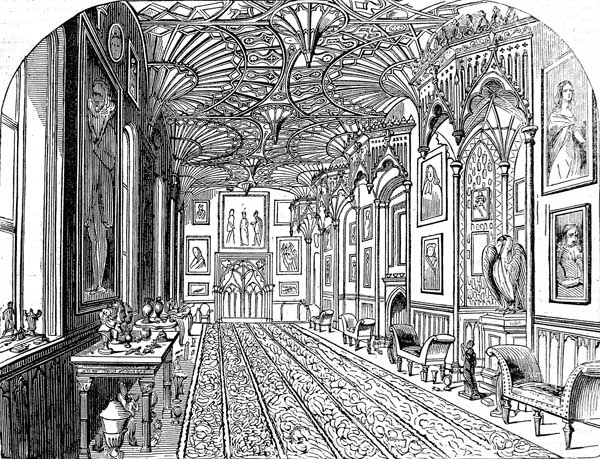
http://upload.wikimedia.org/wikipedia/commons/4/4c/Strawberry_Hill_Illustrated_London_News_1842.jpg  Strawberry Hill, the gothic-revival mansion in west London is currently in the midst of a £9m restoration.  Martin Bailey has a terrific story in the Art Newspaper on the efforts to track down many of the objects which were originally included in the mansion. 

Horace Walpole built the home in the 18th century, which is credited for the revival of the Gothic style in Victorian England.  The building was inspired by the fan vaulting at Westminster Abbey, bits of tombs from Westminster and Canterbury, and the tomb of Edward the Confessor.  When Walpole died in 1797, most of the objects remained at the mansion, but an auction in 1842 led to the loss of a number of the objects.  The Strawberry Hill Trust is now eager to bring these objects back together, including paintings, sculpture, furniture, ceramics, glassware, weapons, relics and manuscripts.

Some of the most sought-after items include:

1. A Roman funerary urn: The Roman urn appears below the window in a 1750s drawing of Walpole in his library by Johann Müntz. Its triangular top decoration has a tripod relief, supported by griffins.
2. Mirror with portrait of Viscount Malpas: There were two mirrors, and the lost mirror has a circular painting of Viscount Malpas. The Gothic mirror, with an ebonised wood frame, was sold in 1842 to Mrs Dawson Damer. Another mirror depicting the Earl of Orford survives (pictured, it was accepted in lieu of inheritance tax last year and will be displayed at Strawberry Hill).
3. Ornate Turkish dagger: The ornate dagger was reputed to have belonged to Henry VIII. In 1842 it was bought by actor Charles Kean, who is said to have used it on the stage. It was sold at Christie’s in 1898 to someone named as Haigham. It is depicted in a late 18th-century watercolour.
4. Gothic dining table Commissioned by Walpole in 1754, the top is of Sicilian jasper (6 x 3 feet), with the frame in black. An early 19th-century drawing of it survives. The ornately decorated table was last recorded in 1953, when it was owned by antiquarian Harry Bradfer-Lawrence, of Ripon, Yorkshire, who died in 1965.
5. Basalt Bust of Vespasian: The colossal basalt bust had been in 10 Downing Street and was later put on display at Strawberry Hill. It is depicted in a watercolour view of Horace Walpole’s gallery. The bust was last recorded at Christie’s in 1893, after leaving the Hamilton Palace collection.
  1. Martin Bailey, Strawberry Hill on the hunt for lost Walpole treasures, The Art Newspaper, January 6, 2010.
Questions or Comments? Email me at derek.fincham@gmail.com

Portable Antiquities Seized in Iraq

Iraqi police announced today the seizure of 39 antiquities discovered hidden near a shrine outside Nasiriyah in Southern Iraq.  These included clay tablets and statues, some of which may date from the 4,000 year-old Sumerian civilization. Are these objects from one of Iraq’s museums?  Were these objects looted from nearby archaeological sites?  If I could speculate on why the objects were hidden near a shrine: it may have been a convenient place to hide these looted objects for sale to visitors to the shrine. 

  1. Katherine Houreld, Iraqi police seize artifacts amid smuggling fears – Washington Times, Associated Press, January 5, 2009.
Questions or Comments? Email me at derek.fincham@gmail.com

Holiday Art Theft in Southern France

Two high-profile art thefts occurred in Southern France in and around the New Year. 

The first was the theft of this work, Les Choristes by Edgar Degas which was reported missing from the Cantini Museum in Marseilles.  The theft was discovered when the museum reopened after the holiday, and was on loan from the Musée d’Orsay which was set to end on January 3rd.  The painting was unscrewed from the wall, and there was no evidence of forced entry.  Mark Durney points out that 2009 began much the same way, with thefts from a Berlin art gallery, and Southern France is no stranger to art crime.  The easy access the thief had to the work has led to the arrest of a night watchman at the museum. 

The second theft occurred in in La Cadière d’Azur, a village in Provence.  As many as thirty paintings were taken from a private home, including works by Picasso and Rousseau.  The owner was on holiday in Sweden. 

Big holidays are a difficult time for security.  Police, owners and the public all have different priorities during these festive days, which makes art particularly vulnerable. 

  1. Picasso, Rousseau works stolen in France days after Degas drawing taken, Telegraph.
  2. AFP: Picasso, Rousseau paintings stolen in France, January 2, 2010.
Questions or Comments? Email me at derek.fincham@gmail.com

The Year in Cultural Policy

2009 saw a number of interesting trends in cultural heritage law and policy.  Below are a few of the year’s prominent stories.  On a personal note, I am still enjoying the fellowship at Loyola in New Orleans; but still looking for a permanent position that will allow me to continue writing and thinking about cultural heritage.  But in the mean time your interest and support continues to enrich and support my work.  There is a need for people to continue thinking and writing about culture.  The blog saw a lot of  interest this year, with nearly 80,000 visitors.  I’d like to thank you all for your interest, comments, and helpful notes and conversations. 

The Four Corners Antiquities Investigation


A large federal investigation into the illegal trade in Native American Artifacts signaled a growing commitment of federal authorities into policing Native American artifacts.  A June 10th raid which searched the homes and businesses of over 20 people lead to arrests, and even two suicides.  So far charges have emerged in Utah, but charges may emerge in New Mexico, Arizona, Nevada, and perhaps even Colorado.

Ongoing Repatriation Efforts

Repatriation continued to dominate headlines this year.  Peru, Egypt, Greece and other nations brought suits and made charges in the press.  One of the most interesting stories which emerged early in 2009 were the efforts by China to secure the return of objects  taken during the period of colonialism.  Many of the prominent details emerged in the press.  In February an auction of many works of art from the Yve Saint Laurent auction became the proving ground for China’s cultural diplomacy.  These two bronzes were slated for sale at the auction, having been looted from the Old Summer Palace in Beijing in 1860.  China first threatened suit against Christie’s, but that suit was denied. At the auction, Cai Mingchao, the general manager of Xiamen Harmony Art International Auction Co. was the winning bidder on these bronzes.  Yet he refused to pay, essentially sabotaging the auction.  This was another indication of the increasing role that nations of origin are playing in the heritage marketplace.  I’m not sure how many wealthy bidders would be willing to stake their reputation or future ability to bid on such a move in the future, but this was a cunningly simple, very shrewd strategic move by Mingchao and the Chinese.  They wanted to disrupt the market in these objects which had been looted, and did a brilliant job doing so.  

Deaccession

The decision by museums to sell works of art generated considerable controversy this year, and no dispute better encapsulates the difficulties which arise than the decision by Brandeis University to close the Rose Museum of Art.  The University has shifted its position  since the initial announcement.  It has announced its intention to maintain the Rose in some form, but given the University’s financial difficulty the decision was not made lightly.  One of the difficulties with deaccession stems from its connection to our fundamental view of art and museum governance.  What is the nature of art?  An art museum?  Are either permanent?  Can we trust the governing structures in our museums?  Our inability to find common ground in crafting answers to these questions accounts for the continued difficulty.  But if the arts community cannot come together and craft viable solutions to these difficulties, we are going to be left with weaker cultural institutions and risk losing more works as a result of financial difficulty. 

Treasure Seekers in the United Kingdom

Earlier this year Oxford Archaeology released a report on the management of undiscovered antiquities in England and Wales.  The conclusion?  Illegal metal detecting in England has declined since the United Kingdom amended the Treasure Act and created the Portable Antiquities Scheme. This has led to the amateur discovery of some beautiful objects, including this Anglo-Saxon hoard discovered by a detectorist this summer.

And of course art theft continued to occur with alarming regularity.


Questions or Comments? Email me at derek.fincham@gmail.com

Odyssey/Spain Dispute Headed to 11th Circuit Appeal

The dispute between Odyssey Marine Exploration and Spain over a shipwreck which was sunk in the early 19th Century will now likely be headed for appeal.  Federal District Court Judge Steven Merryday has issued an order that has adopted the Federal Magistrate’s Report and Recommendation.  In his order Judge Merryday stated a separate opinion would “add only length and neither depth nor clarity (and certainly not finality) to this dispute.”  Though this is a win for Spain, it also means the 11th circuit will now hear an appeal.   Back in the Spring, federal Magistrate Pizzo held the Federal District Court lacked jurisdiction over the dispute and the property should be returned to Spain. 


As I wrote then, though Odyssey Marine attempted to hide the true identity of the wreck, initially code-naming the wreck the Black Swan, there was enough information to conclude the coins came from the “Nuestra Senora de las Mercedes”, a warship which was carrying treasure back from Peru when it was sunk by the British off the Spanish coast in 1804. Spain, soon declared war on Great Britain, a point which may be lost in all this talk of the treasure. This treasure was an important piece of heritage, and all the talk of Odyssey’s share prices, and the rich treasure haul shouldn’t distract us from why these objects are protected, and why Spain fought so vigorously to have them declared the owner.This latest development then is not terribly surprising.  The case involves some complex issues of international admiralty law, and half a billion dollars in gold and silver coins.  It should be a fascinating appeal, as the 11th Circuit will set a precedent governing how these salvors can explore and remove historical objects from the ocean floor.

Odyssey Marine has a press release here.

James Thorner, Odyssey Marine’s treasure tangle with Spain moves to appeals court,  St. Petersburg Times, Dec. 23, 2009.

Richard Mullins, Sunken treasure case headed to federal appeals courtTampa Tribune, Dec. 23, 2009.  

Questions or Comments? Email me at derek.fincham@gmail.com