Many Thanks to ARTHattack!

I want to give a big thank-you to the folks at the University of Guelph and Dr. Susan Douglas. Last Friday I was fortunate to have been asked to give a keynote address to the  ARTHattack! symposium at the University of Guelph. I’ve attended my share of conferences, and I can certainly say this was one of the very best, well run, with terrific papers. This year the topics included:

  • Lucina Pinto – Appearance Versus Reality in Jean Rhys’s After Leaving Mr. Mackenzie: Ekphrastic Encounters and Postcolonial Discourse 
  • Jennifer Graham A Life Seen of Obscenity: Robert Mapplethorpe and The Public’s Perception 
  • Jocelyn Burke Sublime (re)Visions Sarah Carter Interpretation is the revenge of the intellect upon art: Titian’s Sacred and Profane Love 
  • Angel Callander Postmodern Pastiche: the Internet and Dadaism 
  • Vanessa Tignanelli Courtesans in Sixteenth-Century Venice: Exploring Ambiguity in Titian’s Female Portraits
And these were all undergraduates! They set a very high standard. 
Earlier this week I also got to sit in on Dr. Susan Douglas’ seminar course examining art crimes. There were some very thoughtful conversations, and a lot of interesting ideas to cover from the broad perspective of art history. Too often the cultural heritage debates are boiled down to museums v. archaeologists or source v. market. 
But art history gives us a number of useful tools for examining forged art, to take one example. How can art historians create an aura for objects with good histories, or modern recreations of ancient art? Grappling with these issues offers a fresh perspective, and it was refreshing to think about the wonderful tools art historians can bring in examining the abstract ideas connecting this material with culture. Thank you!
Questions or Comments? Email me at derek.fincham@gmail.com

Germany’s Master Art Forger

A forgery of a work by Molzahn

German art forger Wolfgang Beltracchi was sentenced to six years in prison for counterfeiting 14 paintings by Fernand Leger, Max Ernst and Heinrich Campendonk. But there may be many more forgeries:

Beltracchi and three accomplices were sentenced after just nine days at the Cologne District Court, with the defendants receiving shorter sentences in exchange for full confessions. But in a SPIEGEL interview the 61-year-old has now admitted to creating phoney works by “about 50” different artists. Speaking to the media for the first time since he was sentenced, Beltracchi refused to name the exact number of paintings he forged throughout his career, which he began in the 1970s by creating “unpainted works by old masters, and later Jugendstil and Expressionists” and selling them at flea markets. But during the interview with SPIEGEL, Beltracchi said that due to high demand, he could have easily put “1,000 or 2,000” forgeries on the art market.

  1. Ringleader Reveals He Faked Many More Works, Spiegel Online, March 5, 2012, http://www.spiegel.de/international/germany/0,1518,819409,00.html (last visited Mar 8, 2012).

Questions or Comments? Email me at derek.fincham@gmail.com

Turkey Imposes Cultural Embargo on Museums with Contested Objects

The Art Newspaper reports that Turkey has refused to lend objects to museums in the US and UK until issues over disputed objects are resolved.

    The British Museum had asked for 35 items for the exhibition “Hajj: Journey to the Heart of Islam” (until 15 April). Although Turkish museums were agreeable to the loans, the ministry of culture blocked them, leaving the British Museum to find alternative artefacts at short notice. As part of the growing Turkish campaign, loans have been blocked to museums with disputed objects in their collections. The Met has confirmed that a dozen antiquities are now being claimed by Turkey, but would not identify the individual items. A museum spokeswoman says: “The matter is under discussion with the Turkish authorities.” This month, the Met is due to open “Byzantium and Islam” (14 March-8 July). Many loans are coming from the Benaki Museum in Athens, with none requested of Turkish museums.

  1. Martin Bailey, Turkey blocks loans to US and UK, The Art Newspaper, March 1, 2012, http://www.theartnewspaper.com/articles/Turkey-blocks-loans-to-US-and-UK/25869 (last visited Mar 1, 2012).
Questions or Comments? Email me at derek.fincham@gmail.com

Cambodia Disputing a Koh Ker statue up for auction at Sotheby’s

The disputed limestone Koh Ker statue

Cambodia is asking for assistance from the U.S. government in repatriating a limestone statue which was likely looted during the Vietnam War/Khmer Rouge era. Jane Levine, compliance director for Sotheby’s argues that “there are widely divergent views on how to resolve conflicts involving cultural heritage objects”. Here is mine.

The statue has considerable value, its pre-sale auction price was estimated at between $2-3 million. That estimate will likely be considerably less after the report in the New York times, detailing the dubious history of the object. Sotheby’s claims the object was acquired by a “noble European lady” in 1975. Hardly a complete history of the object, and hardly enough to invoke the protections of good faith. The absence of information should not confer the benefits of a good faith purchase. Sotheby’s argues the burden should be placed on Cambodia. I wonder though if the blunt reality of two feet without a body might lead a thinking person to a different conclusion. No museum can ethically acquire this object. Though the Norton Simon has a similar statue, also without feet, no word yet on whether Cambodia may seek the repatriation of that statue as well.

I would expect if a resolution between Sotheby’s and Cambodia cannot be reached that the government consider using its forfeiture powers on the grounds the statue was under the ownership of Cambodia after a 1925 French colonial law declaring objects in Cambodia to be the exclusive property of the state.

Should the forfeiture proceeding be declined, I would urge Cambodia or its lawyers to consider using a civil action using as a precedent the English case, Bumper Development Corp. v Commissioner of Police for the Metropolis [1991] 1 WLR 1362. That case successfully achieved the repatriation of an object taken from an Indian temple, but it was the temple itself was given legal rights as a party. Perhaps there is a legal personality in Cambodia which might offer a similar connection to this statue.

    A Pedestal in Cambodia, which might be the base
  1. Tom Mashberg & Ralph Blumenthal, Sotheby’s Caught in Dispute Over Prized Cambodian Statue, The New York Times, February 28, 2012, http://www.nytimes.com/2012/02/29/arts/design/sothebys-caught-in-dispute-over-prized-cambodian-statue.html (last visited Feb 28, 2012).

Questions or Comments? Email me at derek.fincham@gmail.com
Thank You

Calder’s Flamingo in front of the Dirkson Federal Building

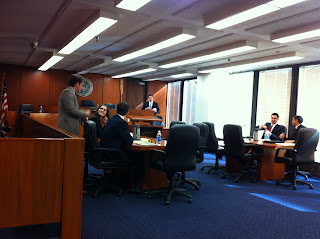
I just want to thank everyone who had a hand in organizing the Cultural Heritage Moot Court Competition in Chicago last weekend, especially the folks at DePaul and the Lawyers Committee for Cultural Heritage Protection.

I heard a lot of strong arguments all weekend, with a very strong team from Chicago-Kent edging out a South Texas team of Adriana Lopez, Joe Bramanti and Joel Glover in a well-argued final round.

I especially want to thank the two teams from South Texas who competed at a very high level, with Brian Evans earning a tie for best orallist—and along with his teammate Chris McKinney earning the runner up for best brief. The best-argued round of the weekend came when the two South Texas teams were paired up in the quarterfinals, and in a close round Adriana and Joel won. Both teams knew each other’s arguments so well—it was a shame they were paired up so early in the competition.

These guys were awful fun to coach.

Questions or Comments? Email me at derek.fincham@gmail.com

Good Luck

Best of luck to all the teams competing at the Cultural Heritage Law Moot Court Competition in Chicago this weekend. The competition is sponsored by DePaul and the Lawyers Committee for Cultural Heritage Protection.

The problem involves a defendant challenging her conviction under the Theft of Major Artwork Act, passed partly in response to the theft at the Isabella Stewart Gardner Museum.

Questions or Comments? Email me at derek.fincham@gmail.com

Footnotes

Questions or Comments? Email me at derek.fincham@gmail.com

More on Antiquities Thefts

Last week was a bad week for antiquities protection, as thefts of antiquities from both Montreal and Olympia in Greece were revealed. It reminds us that antiquities are vulnerable in archaeology, but also when they are displayed in museums, just as works of art are.

Both instances are troubling examples of thieves overcoming museum security. But, to borrow a phrase from Prof. Merryman, no thinking person would use these thefts to argue that (1) Western museums should repatriate all their antiquities; or (2) Greece should sell its “surplus” antiquities to alleviate its culture funding difficulty. Both propositions are wrongheaded. They are a reason why cultural heritage policy has such difficulty getting off the ground, if the discourse can’t even acknowledge and admonish thieves as thieves.

With respect to the Olympia thefts, there is not much to report since last Friday’s theft. Channel 4 has a short video report showing the interior of the museum and images of the kinds of objects which were stolen. Dick Ellis, who formed the Art and Antiques Squad (and also lectures in ARCA’s Summer Program in Amelia) is quoted in the piece. He notes that

 It has become an organised crime business the incentive is there to make money in Greece. . . . And they may well begin a life which sees them travel from the poorer hands of the lowly thieves who broke into the museum to reach the lucrative shores of London or New York, and in some cases, find themselves auctioned off for tens of millions of dollars. . . . I am sure the current economic situation is Greece is triggering people to become more active, . . . I would expect these objects are going to get moved. It’s a transitional country for other stolen goods, and they can go west or east.

The Channel 4 Video:


  1. Armed robbers loot ancient Greek museum – Channel 4 News, (2012), http://www.channel4.com/news/armed-robbers-loot-ancient-greek-museum (last visited Feb 20, 2012).
Questions or Comments? Email me at derek.fincham@gmail.com

Antiquities and the New Leadership at the Getty

Jason Felch reports for the LA Times on the new director of the Getty Museum, Timothy Potts, who has opposed reforms of the antiquities trade. He will join James Cuno, the Getty Trust CEO, who has also been critical of efforts to restrict the flow of looted antiquities. The Getty has a very strict acquisitions policy, so I’m not sure how much their criticism of the reform will lead to the actual acquisition of objects. They will be subject to a great deal of scrutiny like this report where Felch details a previous controversy involving a Roman torso:

 In late 2000, Potts approved the acquisition of a rare Sumerian statuette for $2.7 million. The 15-inch alabaster figure was an ancient masterpiece from the cradle of civilization, the region Potts had specialized in while studying at Oxford. It was to be an important contribution to the Kimbell’s small but highly regarded collection. 

But shortly after the statue arrived at the museum, court records show that Potts took the unusual step of returning it to the dealer and asking for a full refund. 

Publicly, Potts said that he wanted to free up money for other acquisitions. But he later testified that he had learned the dealer — Hicham Aboutaam, owner of the New York City antiquities gallery Phoenix Ancient Art — was under investigation by the IRS, and decided against buying from him. 

Soon, though, Potts changed his mind about doing business with Aboutaam. After receiving repayment for the Sumerian statuette in November 2001, Potts moved to acquire a $4-million Roman torso he had admired on an earlier visit to Aboutaam’s gallery on East 66th Street in Manhattan.

  1. Jason Felch, Antiquities issue rears head with Getty leaders Potts, Cuno in place, Los Angeles Times Articles, February 17, 2012, http://articles.latimes.com/2012/feb/17/entertainment/la-et-getty-antiquities-20120217 (last visited Feb 20, 2012).
Questions or Comments? Email me at derek.fincham@gmail.com

Armed Antiquities Theft from the Greek Museum in Olympia

The Museum in Olympia, before the theft

There has been another museum theft in Greece. At 7.30 local time this morning two masked men overpowered a security guard and stole between 60-70 objects. The Museum guard was tied and gagged. The BBC reports that “the robbers – one of whom had a gun – targeted the guard during a shift change, after having already knocked out the alarm.” Most of the stolen items were small bronze, gold, and clay statuettes, which will be very easy to hide, and unfortunately easy to sell. The thieves were dressed in military fatigues, and were well-armed. Police have described it as a “well-calculated” hit. But other reports indicate the thieves spoke only broken Greek, and that they weren’t familiar with the museum, asking where objects like a gold wreath were, even though the museum had none of those objects.

This theft comes after the theft from the National Gallery in Athens, and amid protests and fires which have destroyed some buildings. It also has caused the Greek Culture Minister Pavlos Geroulanos to resign. Connections will be drawn to Greek austerity, but whether it was funding cutbacks which have made this theft possible has not been established. There was a breakdown of security here, and it may be that thieves saw the thefts in Athens and were brazened. A culture ministry official told the AP that the thieves “seem to have operated more as if they were carrying out a holdup”.

Yiannis Mavrikopoulos, head of the culture ministry museum and site guards’ union put the cutbacks squarely at the feet of the bodies urging Greek cutbacks: “The cutbacks imposed by the European Union and the International Monetary Fund have hurt our cultural heritage, which is also the world’s heritage . . . There are no funds for new guard hirings, . . . There are 2,000 of us, and there should be 4,000, while many have been forced to take early retirement ahead of the new program of layoffs. We face terrible staff shortages. As a result, our monuments and sites don’t have optimum protection – even though guards are doing their very best to protect our heritage. ”

  1. Robbery at Ancient Olympia museum, BBC, February 17, 2012, http://www.bbc.co.uk/news/world-europe-17071934 (last visited Feb 17, 2012).
  2. Nicholas Paphitis, Museum robbed at Greece’s Ancient Olympia, Google News, February 17, 2012, http://www.google.com/hostednews/ap/article/ALeqM5hueW4Ohi6iY0JYUbVnIZslcSHwoA?docId=f762a40068e9489dacd391175db3023e (last visited Feb 17, 2012).
Questions or Comments? Email me at derek.fincham@gmail.com