Owners of ‘orphaned’ objects find donations difficult now

A detail from one of the Sevso objects, the most
notorious collection of ‘orphaned’ objects

An interesting report in today’s N.Y. Times discusses the difficulty some collectors of antiquities are having when they decide to donate their collections to museums:

But his giving days are largely over, he said, pre-empted by guidelines that most museums now follow on what objects they can accept. “They just won’t take them — can’t take them,” Mr. Dewey said. Alan M. Dershowitz, the Harvard law professor, is in a similar bind. An antiquities collector, he is eager to sell an Egyptian sarcophagus he bought from Sotheby’s in the early 1990s. But he is stymied, he said, because auction houses are applying tighter policies to the items they accept for consignment. “I can’t get proof of when it came out of Egypt,” Mr. Dershowitz said.
The main omission from the report though, is that it only really gives the perspective from the point of view of collectors, without really giving much in the way of the consequences of buying these illicit objects.

There is a collection of reactions which give the perspective of the cultural heritage movement. But one big piece missing from the report involves the tax deductions received for these donations (and I’m pretty sure Neil Brodie and Patty Gerstenblith would have made this known to the authors of the piece).When an illicit object is donated, the donor receives a lucrative tax deduction, which can often exceed its real value. As a consequence the American taxpayer is then subsidizing the illicit antiquities trade, and helping to pay for the continued looting of sites.

I can appreciate the concerns of collectors who have acquired objects without informing themselves of the issues involved in the antiquities trade; who now find themselves surprised to have a very valuable piece of ancient art; and nobody is now willing to accept it as a donation. But this is a necessary consequence of the lack of information given by auction houses and dealers to these folks—especially the buyers who have money, but don’t know what they are actually buying. Some objects may be orphaned, but if the trade itself responds to this correction and pressure exerted on behalf of the owners of these ‘orphans’, then that might very well be worth the costs. Buyers won’t be buying objects if there is no further market for these objects, and the market itself rejects objects without provenance and information.

 Consider as well that many of these objects may not be real to begin with. Without information on an object’s history, we have lost the best most cost-effective means of knowing if an objects is in fact not a fake.

  1. Ralph Blumenthal & Tom Mashberg, Antiquity Market Grapples With Stricter Guidelines for Gifts, N.Y. Times, July 12, 2012.
Questions or Comments? Email me at derek.fincham@gmail.com

Footnotes

Now you see them: the eternal allure of lost art | Art and design | The Guardian Source URL:http://www.guardian.co.uk/artanddesign/2012/jul/01/gallery-of-lost-art These early modern artists were rebelling against the pompous art world of the 19th century, where rich and lauded painters would exhibit massive oil paintings at the Paris Salon or the Royal Academy, each developed through an academic series of drawings. Why, these rebels asked, should art be a glossy treasure? Working in ramshackle studios, drinking absinthe, they treated their own genius in a deliberately nonchalant and casual way. In the National Gallery in London, you can see Edouard Manet’s 1867-8 painting The Execution of Maximilian – or at least fragments of it. This pioneer of the avant garde cut off part of the canvas himself; after he died, it was cut up further in order to be sold in pieces. It took his admirer Degas to buy all the fragments he could find and paste them together as best he could. Growing Number Of Tourists Stealing Artifacts In Rome, Italy | Gadling.com Source URL:http://www.gadling.com/2012/06/28/growing-number-of-tourists-stealing-artifacts-in-rome-italy/ For those who love admiring ancient artifacts, you may want to visit Rome while they’re still there. According to police, there has been an outbreak of tourists stealing mosaic pieces, marble mile markers, cobblestones and other pieces of the city’s history. Luckily, airport security has been vigilant and is on the lookout for the items. In fact, they’ve been able to return a large amount of artifacts stolen in the last six months. Moreover, they’re finding the majority of the thieves are travelers coming from Britain and northern Europe. These people are not arrested, but instead given a stern warning. Says Police Chief Antonio Del Greco, “I can understand the legend and splendor that is Rome but that does not mean bits of it should be stolen … If they want a souvenir of their visit then they should buy something from a shop.” Sea surrenders pristine Roman sarcophagus – The Art Newspaper Source URL:http://www.theartnewspaper.com/articles/Sea+surrenders+pristine+Roman+sarcophagus+/26909 A Turkish press report describes the sarcophagus discovery Diving school trainer Hakan Gulec came across more than fish and flotsam during a recent trip to the bottom of the ocean near Antalya off the coast of southern Turkey. An object protruding through the sand on the sea bed caught Gulec’s attention, prompting the intrepid explorer to dislodge and photograph the mystery find. Vandalized Banksy piece worth up to $620,000 is whitewashed over – latimes.com Source URL:http://www.latimes.com/entertainment/arts/culture/la-et-cm-london-vandalized-banksy-20120706,0,4757465.story?track=rss&utm_source=dlvr.it&utm_medium=twitter&dlvrit=175674 A Banksy piece in London was vandalized by graffiti crew Team Robbo. (www.london24.com) By Jamie Wetherbe July 6, 2012, 8:10 a.m. A defaced stencil by the elusive street artist known as Banksy — which might have quadrupled in value after being vandalized — has been cleared from a London neighborhood. The artwork of a boy blowing bubbles that spell out the name “TOX,” a prolific tagger jailed last year for his handiwork, appeared last August on a wall along Jeffrey’s Street in the city’s northwest neighborhood of Camden Town. Smugglers lead police to ancient loot | News.com.au Source URL:http://www.news.com.au/breaking-news/world/smugglers-lead-police-to-ancient-loot/story-e6frfkui-1226420093890 POLICE in Karachi have seized dozens more stolen ancient artefacts dating from the Gandhara civilisation. The catch came thanks to leads obtained from those arrested in a similar raid the day before, officials said. The antiquities had been illegally dug from the country’s restive northwest where Pakistan’s army is battling against Islamist militants. The latest raid on a warehouse in the eastern Ibrahim Hyderi neighbourhood unearthed two large boxes stuffed with ancient Gandhara art.

Footnotes

The Curious Case of SpongeBob SquarePants Illustrator Todd White, Three Ninjas, and an Art Caper | Culture | Vanity Fair

A truly bizarre tale:

Artist Todd White seemingly had it all. With a multi-million-dollar art brand, collectors and clients ranging from Sylvester Stallone to Coca-Cola, and a burgeoning reputation in art-mad Britain, his days as lead character designer of SpongeBob SquarePants were but a distant memory. But, as David Kushner reports, when his confidante and gallerist Peggy Howell reported a burglary of his paintings at the hand of ninjas, things took a turn for the even stranger.

Theft of Dalí Drawing Was Incongruous in its Simplicity – NYTimes.com

altThe man who stole a drawing by the Surrealist painter Salvador Dalí on Tuesday wore only the most basic of disguises: that of an everyday gallery visitor, walking past the Jeff Koons and Damien Hirst works on display. And he brought only the most basic of tools for his heist: a black shopping bag. When he left the new Venus Over Manhattan gallery on Madison Avenue and escaped into a sunny afternoon, no one — not the security guard standing watch in the gallery, not the guard in the building’s lobby — realized that a thief was making his getaway. The loss of the drawing, “Cartel de Don Juan Tenorio,” valued at $150,000, was a blow to the gallery, near East 77th Street, which has been open for only a month. Its high-society origins and high-concept exhibition have attracted much attention. Its owner is Adam Lindemann, a wealthy art collector and writer whose wife runs another gallery.

 And of course the painting was recovered after it was mailed back to the US from Greece.

To keep the looters away from De Soto site and Spanish mission, Ashley White came up with an elaborate ruse | Gainesville.com

“The artifacts, individually, are not very valuable monetarily, but historically they have tremendous value,” White said. But treasure hunters aren’t easy to deter. To keep the looters away from the real treasures, White had to come up with an elaborate ruse. White created a phony archaeological dig on a distant part of his property near Orange Lake, complete with orange markers, wooden grids and strings methodically placed to give the illusion that important work was taking place there.

An account of ARCA’s annual conference by Rebecca Junkemeier with SPI:

Here at SPI, we want to provide local communities with the entrepreneurial opportunities to create sustainable income from their cultural heritage; income that is dependent on the preservation of the site. SPI left Amelia with the conviction that focus on the local is imperative to success, and that, now more than ever, the development of local economies is instrumental in saving the world’s cultural heritage for future generations to study and enjoy.

Master forger comes clean about tricks that fooled art world for four decades | Art and design | The Observer

An extraordinary memoir is to reveal how a gifted artist managed to forge his way to riches by conning high-profile auctioneers, dealers and collectors over four decades. The book, Caveat Emptor: The Secret Life of an American Art Forger, will be published next month and tells the story of Ken Perenyi, an American who lived in London for 30 years. The revelations within it are likely to spark embarrassment on both sides of the Atlantic.

U.S. returns stolen art worth millions to Italy | Reuters

The United States on Wednesday returned stolen art works worth millions of dollars to Italy, including two 2,300-year-old ceramic vases, a Roman sculpture and a Renaissance painting. The seven works, which Italian police said were illegally smuggled into the United States by organized crime groups specializing in stolen art, will now be returned to their owners and museums. “The recovery of these works of art was thanks to professional cooperation between law enforcement in Italy and the United States,” said Italian Culture Minister Lorenzo Ornaghi. “The recovery of art is an important chapter in our history of cooperation,” he told a news conference at the U.S. embassy.

Questions or Comments? Email me at derek.fincham@gmail.com

The Weiss Case: Pleading Guilty to Getting Duped

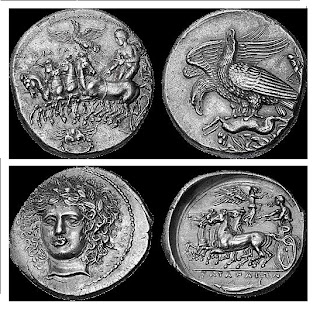
Two “genuine fake” ancient coins

My grandfather once had a shiny piece of jewelry (I think it was a cubic zirconia pinky ring) which he would describe as a “genuine fake diamond ring”. He would say it fast enough that if you weren’t listening close you thought he would just say ‘genuine’.

Early this year a prominent physician, Arnold Peter C. Weiss, was arrested and charged with dealing in recently looted coins. Last week Weiss pleaded guilty to three counts of attempted criminal possession of the coins. He thought they had been recently excavated. But they were in fact modern forgeries—a predictable consequence of not asking enough questions about the history of these objects before their acquisition. Unlike Charles Stanish, who is heartened by these fakes which don’t cause the looting of a site, I think these fakes do pollute our understanding of the past and defraud our collective cultural heritage.

Chasing Aphrodite reports that as part of the plea agreement reached with the Manhattan District Attorney’s office, the defendant must serve 70 hours of community service, forfeit 23 other ancient coins seized, and pay a $3,000 fine. But he has some writing to do as well:

The court also required Weiss, the former treasurer of the American Numismatic Society, to write a detailed article in the society’s magazine detailing the widespread practice of dealing in coins with unclear ownership histories. It will describe the corresponding threat to the archaeological record and propose solutions for reforming the coin trade. In a statement, a spokeswoman for the Manhattan District Attorney’s office said, “Thanks to today’s disposition, the article to be written by the defendant for a coin trade magazine will raise needed awareness about unprovenanced coins, and will promote responsible collecting among numismatists.”

It should be a real page turner. I suspect Matthew Bogdanos, the Manhattan assistant DA had much to do with that writing assignment.

Paul Barford notes of the fakes:

Those coins always looked to me suspect, too fussy and the Akragas looked like it was a copy of another in a published collection, but who am I to question what the US authorities are up to, eh? (back in January, I was asked to keep my suspicions to myself, so did, but glad to see I am not going crazy). Anyway it turns out that those “priceless ancient coins” “weren’t worth a wooden nickel”.

Rick St. Hilaire thinks this case may be the start of increased use of state laws to police the illicit antiquities trade:

Indeed, all fifty states have receiving stolen property laws on the books, which can be applied in cases where a person is in criminal possession of stolen cultural property. The states also have “attempt” laws, which would cover a person’s attempt to possess stolen cultural property or possession of forged cultural property believed to be authentic. Beyond these statutes, the states maintain consumer protection laws with applicable penalties to guard against the appearance of fraudulent and stolen items in the marketplace. The states also have nonprofit enforcement statutes that may be applied to specific cultural institutions or boards of directors that acquire illegal art, archaeological finds, or ethnological artifacts.

Let’s hope so. But the same obstacle to state prosecutions exists for federal prosecutions as well. The trade makes it terribly difficult to gather sufficient evidence to establish wrongdoing in an anonymous trade. Bogdanos has been looking hard for a dodgy antiquities dealer to prosecute since the Baghdad museum looting. He has one now. But Weiss was duped by the under-regulated antiquities trade. Perhaps that notion will cause him to sit down to write his assignment with some real vigor (Peter, if you are reading, I’m happy to read a first draft). 

Questions or Comments? Email me at derek.fincham@gmail.com

Troubling News of Destruction in Mali

This image taken from a video shows armed men smashing a
15th century mosque in Timbuktu on Monday

Members of an armed group in Northern Mali have committed a number of acts of destruction in Timbuktu and the surrounding areas. They have smashed the “sacred door” of one of three ancient mosques. As many as six other mausoleums have been intentionally destroyed. Intentional destruction during armed conflict presents difficult problems, and Mali has asked the international community for concrete assistance.

The first step is a threat by the ICC. The prosecutor of the International Criminal Court Fatou Bensouda has described this destruction as a war crime: “My message to those involved in these criminal acts is clear: stop the destruction of the religious buildings now. This is a war crime which my office has authority to fully investigate”. Her claims may have an impact, but more other concrete steps may be needed to halt this intentional destruction.

The destruction mimics that which took place in 2001 when the Bamiyan Buddhas were destroyed. Extremist groups in Mali are systematically destroying sites. Perhaps urgent action by the ICC, or better yet the United Nations Security Council can halt this systematic destruction.

From Al Jazeera, here is a report showing the destruction:

  1. Pascal Fletcher, Timbuktu tomb destroyers pulverise Islam’s history, Reuters, July 3, 2012, http://www.reuters.com/article/2012/07/03/uk-mali-crisis-timbuktu-idUSLNE86202G20120703 (last visited Jul 3, 2012).
Questions or Comments? Email me at derek.fincham@gmail.com

Dr. Laurie Rush on "Cultural Property Protection as a Force Multiplier"

Laurie Rush, and Army archaeologist who has directed the In Theater Heritage Training Program for Deploying Personnel has a very interesting piece tin the March-April edition of Military Review, Cultural Property Protection as a Force Multiplier in Stability Operations The piece focuses on the work of the Monuments officers during WWII, but has much to say about the continued importance of heritage protection today. An excerpt:

Few contest the long-term value of cultural property protection during fullspectrum operations. However, one might reasonably question its immediate benefits to Western military personnel facing hostile engagements in today’s complex conflict situations. One immediate response refers to the media battle that is an inevitable part of all modern conflict. Just as the Italians and Germans used propaganda effectively to advance their causes during the African and Italian campaigns, the terrorists and insurgents of today are often on the scene with video cameras. The British monuments program in 1943 began in part as a response to an Italian propaganda effort centering on the ancient Roman city of Cyrenica in Libya. After the ancient site changed hands from the Italians to the British and back to the Italians, the Italian government put together a propaganda campaign with the message that the British had shown no respect for the glory of ancient Rome. The Italians faked damage to the museum, photographed statues under reconstruction and added captions accusing the British of deliberately breaking them, and offered examples of graffiti written in English. The power of these materials was manifest. They helped convince the Italian people that the British had no respect for any element of Italian or Roman history and culture.

The whole piece merits a good read, highly recommended. I wonder if the protection of these sites and objects can be considered an economic, cultural or other ‘multiplier’ as well, extending the arguments and resources we might dedicate to their protection outside of conflict zones as well.

Questions or Comments? Email me at derek.fincham@gmail.com

The Fourth Annual ARCA Conference

We have just returned from Amelia and the first five weeks of the ARCA program in Amelia. Last weekend ARCA held its fourth annual conference, and the event gets better every year, a fact evidenced I think by how many folks returned to Amelia for the conference again this year. The event brings together a diverse set of talents, which is necessary given the challenges facing heritage advocates. These dangers include theft, archaeological looting, the sale of illicit objects in the market, forgery, and destruction during armed conflict. And the challenge of course when one begins a conference is to ask what one little conversation can do in the face of this heritage crime. Our hope is to take the conversation and carry it back to our work. As we know, many of these conversations focus on the Mediterranean, and the return of illicit objects there (and even the claims for more returns).


This means of course that many other areas of the World are left under-considered. To open the conference I discussed the ongoing case of a looted statue from Koh Ker which has been seized by U.S. attorneys in a forfeiture proceeding from Sotheby’s. We were able to invite with His Royal Highness Ravivaddhana Sisowath, Prince of Cambodia to give some remarks. He spoke about the importance of these statues to the people of Cambodia, and the circumstances surrounding their removal in the conflict during the 1970s involving the Vietnam War and the Khmer Rouge. Later on Saturday we were able to present awards in person to three of the very best kinds of advocates in this field: Joris Kila, an expert in protecting cultural heritage during armed conflict who has visited Libya and other at risk sites; Jason Felch, a reporter for the L.A. Times who has continued important work in this field with ideas like Wikiloot; and finally George Abungu, the Vice-President of ICOM and a powerful advocate for heritage protection. His discussion of African rock art was one of the very best discussions of art and heritage protection I have seen.


There were many other highlights—the presentation from Dr. Laurie Rush on heritage protection as a force multiplier was outstanding, and of course the early career presentations were some of the best of the weekend. 

Many many thanks to everyone at ARCA for such a terrific weekend, including Monica, Lynda, Catherine, Kirsten, Noah, and of course Joni. You can save the date already for our fifth conference, June 22-23, 2013 in Amelia again.  

Questions or Comments? Email me at derek.fincham@gmail.com

Footnotes

Dalí Painting Stolen From New York City Gallery – NYTimes.com

The police are searching for a man who they say entered an art gallery on the Upper East Side on Tuesday, plucked a Salvador Dalí painting from one of its walls, stuffed it in a shopping bag and strolled out without anyone noticing. The man posed as a customer at the Venus Over Manhattan gallery at 980 Madison Avenue, the police said, and fled westbound on East 77th Street.

A Field Class at Cerveteri

Inside la banditaccia at the Etruscan Necropolis near Cerveteri

Last Friday I finished teaching my art and cultural heritage law course here in Amelia as a part of ARCA’s masters certificate program. One of the highlights of my year is coming to Amelia for ARCA’s program, and the field class at Cerveteri captures so much of what makes cultural heritage policy a rich and interesting area  to study—but there are frustrations as well.

First the good. There are beautiful vibrant works of art in the houses for the dead. We met Stefano Alessandrini who took us through the necropolis and the tombs. They now have names like ‘the tomb of the Grecian Urns’—where of course many Greek pieces of pottery were found. And the highlight is the ‘tomb of the reliefs’ with wonderful frescoes, bas-reliefs, and sculptures that portray a number of professions. The images are familiar and comfortable, except maybe for the image of Cerberus on the far wall. The burial complex was quite large, far larger in fact than the protected area of Cerveteri in the banded area. And outside of the protected world heritage site are tombs in need of conservation, some exposed tufo rock tombs, and also some vulnerable unexcavated tombs.

You can see the area from this google maps image. To the right of the white line is the unexcavated or non-conserved area. To the left is the well-kept World Heritage Site.

There was one Italian archaeological excavation of a tomb outside la Banditaccia:

But also we saw a different kind of excavation, there were a few looters pits on the exposed hillside a few hundred yards up the road. These appeared to have been done in the last few months:
At the bottom of the hole you can see the outline of one of the tombs, likely a square tomb. So a looter may return at night and look for the entrance to a tomb. One difficulty is the remoteness of the field here. It’s just out of view of the little dirt track. On a dark night a looter could cover the hole with dark canvas and shine a flashlight underneath to do their work. 
Before the trip I assigned DH Lawrence’s short chapter discussing Cerveteri to the students. Though his scientific knowledge of the Roman and Etruscan civilization was lacking perhaps he did get the feel of these tombs just right. He travelled there in 1927 with a companion, and one imagines the little wine sink just off the main square is the same one where Lawrence popped in and complained about the lunch he ate before walking to the necropolis. But when he stops complaining about the food, the dust, the heat, and the Romans (the ancient ones), he describes a happy feeling walking among the tombs. He envisions the Etruscans thinking about a trip to the underworld. He suggested that the Etruscans might have burned their simple wooden homes (whether this is true or not I am not sure). But the point he draws from this writerly device gets the feeling of the place right. The Etruscans believed in a happy, joyous afterlife, which freed them to live in the moment while they were alive. And it is perhaps no coincidence that the time when Lawrence traveled to Italy and the Etruscan places was a time when Lawrence was diagnosed with Tuberculosis, and he might have been thinking about his own legacy and afterlife.
And he notes that many of the best treasures of the tombs were missing from them. Some had been lost to the humidity of the tufo rock, or to scholarly study and excavation. Others had yet to be looted or excavated . The Sarpedon/Euphronios krater was still resting in its context while Lawrence was walking through the tombs. The terms cultural nationalist and internationalist had yet to be devised and attached to the arguments about the proper place for these objects. But Lawrence is a firm believer in the power of context for the aesthetic experience of the viewer: 

What one wants is to be aware. If one looks at an Etruscan helmet, then it is better to be fully aware of that helmet, in its own setting, in its own complex of associations, than it is to ‘look over’ a thousand museums of stuff. Any one impression that goes really down into the soul, it is worth a million hasty impressions of a million important things.

I guess we all have different views on our favorite way to see art. Walking through a large museum with many objects—millions might be a bit of an exaggeration—is certainly one way. And pairing a trip to the Villa Giulia with a trip to Cerveteri in the same day offers a deeper different experience of seeing the tombs and the objects removed from them in the same day. We can argue about the value of both. But in making the decision, we should respect the law and regulation. Disagree with it, work to change it, work to strengthen it, whatever. But looting, even looting from the distant past, should not be used to avoid or end the conversation.

Questions or Comments? Email me at derek.fincham@gmail.com

Picasso Vandalism at the Menil in Houston

The vandal used a stencil to spray a bull and the Spanish word Conquista (conquer) in gold paint on Pablo Picasso's painting Woman in a Red Armchair.

 A moron has decided to vandalize a Picasso work at the Menil in Houston. This is a few blocks from our house—but we are away in Amelia at the ARCA summer program finishing up my teaching and preparing for the annual conference this weekend. If we were home the spaniels and I would be scouring Houston looking for this dimwit. From the chronicle:

Police are searching for a suit-jacketed suspect who spray-painted graffiti over a Picasso painting at Houston's Menil Collection art museum last week.

Menil communications director Vance Muse, reached in Germany Monday, said the painting was rushed down the hall, with the paint barely dry, to the museum’s renowned conservation lab, where chief conservator Brad Epley quickly began its repair. The vandal, who fled the building and has not been identified, stenciled an image of a bullfighter killing a bull and the word “Conquista” on the painting.

 The vandal used a stencil and spraypaint to damage Picasso’s Woman in a Red Armchair. The work may have been rushed down to the conservation lab, yet the museum security was nowhere to be seen. One of the great charms of the Menil is you can wander in and have the place to yourself on a hot afternoon, but perhaps security needs to pay a little closer attention. 

  1. Molly Glentzer, Picasso vandal hits Menil, Houston Chronicle, http://www.chron.com/entertainment/article/Picasso-vandal-hits-Menil-3642537.php#src=fb (last visited Jun 20, 2012).

Questions or Comments? Email me at derek.fincham@gmail.com