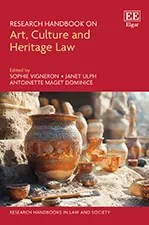
A New Handbook, a Dutch Trial, and the Mona Lisa on Stage

A new Research Handbook on Art, Culture and Heritage Law has just been published by Edward Elgar, co-edited by Sophie Vigneron, Janet Ulph, and Antoinette Maget Dominicé. The volume is a substantial one — 682 pages — and it brings together an impressive range of scholars to examine art, culture, and heritage law through four broad challenges: sustainable development, intergenerational equity, decolonisation, and cultural rights. The publisher describes it as both interdisciplinary and practical, with chapters addressing the definition, protection, and contestation of cultural heritage, alongside subjects such as provenance research, repatriation, trafficking in peacetime, wartime looting, and the intentional destruction of heritage.

The table of contents alone gives a good sense of the range. There are chapters by Patty Gerstenblith on the 1970 UNESCO Convention, Emma Cunliffe on the 1954 Hague Convention, Anne-Marie Carstens on international cultural heritage crimes, Sophia Labadi on world heritage and sustainable development, Neil Brodie on EU Regulation 2019/880 on the import of cultural goods, Emily Peacock and Donna Yates on the online antiquities trade, Evelien Campfens on cross-border restitution, and Andrea Wallace, Francesca Farmer and Mathilde Pavis on restitution beyond the object. My own contribution is a chapter on “Cultural heritage law in the United States.”

In a field that often splinters into separate conversations — market regulation over here, armed conflict there, restitution somewhere else — there is real value in a volume that tries to gather these debates into one place.

For those interested, the publisher’s page is here: Research Handbook on Art, Culture and Heritage Law.

The more immediate news item is the start of the Dutch trial over the theft of major Romanian gold artefacts from the Drents Museum, including the celebrated Coțofenești Helmet, a 5th-century BCE object, and three Dacian gold bracelets. Dutch prosecutors have reportedly sought sentences ranging from 44 to 66 months, and specifically asked for three years and eight months for Jan B. (21) and Douglas Chesley W. (37) after plea agreements aimed at securing the return of the helmet and two of the bracelets.

That cooperation matters. Dutch prosecutors said earlier this month that the Coțofenești Helmet and two of the three bracelets were recovered after discussions with defence counsel and agreements with the suspects; the Public Prosecution Service made clear that a condition of those agreements was the return of the artefacts. Reuters likewise reported that the recovery came with the help of information from the suspected thieves. One bracelet is still missing.

The case is a useful reminder that criminal prosecutions in cultural objects are often doing more than assigning blame after the fact. Sometimes they are structured, explicitly, to recover objects first and punish later. That may be unsatisfying in one sense — especially where the penalties sought do not seem especially severe given the cultural stakes — but it also reflects a hard truth: once an object like this disappears, the first priority is often simply getting it back before it is damaged, dispersed, or lost entirely. In this instance, the helmet was recovered slightly dented, though museum officials say it can be restored.

And then, because the art world never misses a chance to become faintly ridiculous just when things have turned serious, there is this: Andrew Lloyd Webber is apparently working on a musical about the theft of the Mona Lisa. According to The Art Newspaper, the project is based on the 1911 theft by Louvre employee Vincenzo Peruggia, who removed the painting and it later resurfaced in Italy. Lloyd Webber described it as “the true story” of how the painting disappeared for roughly three years and ended up in Italy.

Sophie Vigneron et al., Research Handbook on Art, Culture and Heritage Law (Edward Elgar Publishing, Incorporated Mar. 2026).

Stealing the Show: Mona Lisa Heist Inspires Andrew Lloyd Webber Musical, The Art Newspaper – International art news and events, https://www.theartnewspaper.com/2026/04/13/stealing-the-show-mona-lisa-heist-inspires-andrew-lloyd-webber-musical (last visited Apr. 14, 2026).

Dutch Prosecutors Urge Long Jail Terms for Romanian Helmet Theft, France 24, https://www.france24.com/en/live-news/20260414-dutch-trial-over-theft-of-golden-romanian-helmet-begins (last visited Apr. 14, 2026).

Security, Spectacle, and Return

It has been an oddly revealing week for cultural heritage.

On one end, Dutch officials unveiled the recovered Coțofenești helmet and two gold bracelets at a press conference in Assen, flanked by heavily armed officers in balaclavas. The helmet, stolen from the Drents Museum in January 2025 while on loan from Romania, was recovered with minor damage; though one bracelet remains missing. The recovery appears to have come as part of an agreement with suspects ahead of trial.

A Geto-Dacian helmet dating from the first half of the 4th century BC, uncovered by chance. View from the front.
By © Radu Oltean / Wikimedia Commons, CC BY-SA 3.0, https://commons.wikimedia.org/w/index.php?curid=14615152

On the other end, just days earlier, thieves entered the Magnani-Rocca Foundation near Parma and, in about three minutes, made off with works by Renoir, Cézanne, and Matisse. Reports describe a fast, organized raid by four men who forced entry and targeted highly recognizable names.

And then, in Zurich, Switzerland quietly transferred ownership of 28 Benin Bronzes from three museums, with 18 expected to travel physically to Nigeria in June. That return followed provenance research and was framed, quite rightly, as another step toward reuniting Nigeria with material taken in the 1897 British plunder of Benin.

Three stories, one week, and each says something slightly different about how the cultural heritage world performs security, legitimacy, and justice.

The Dutch press conference was the most visually obvious example. The object had been recovered. Great! That part matters most. But the staging mattered too. Armed guards. Masks. Cloth lift. The careful unveiling of a rescued national treasure. It was a display of regained control. One could almost hear the subtext: yes, it was stolen, but look how seriously we take it now.

That is what struck Donna Yates so clearly in her reaction to the event: the oddity of the whole performance. The recovery of a cultural object becomes not just an announcement, but a kind of theatrical rebuttal to the earlier embarrassment. The state is not merely returning the object; it is staging authority. And perhaps staging reassurance too.

The Italian theft, by contrast, stripped away the theatre. There is no ceremonial dignity in a three-minute smash-and-grab. Only a broken entry point, a short timeline, and the uncomfortable reminder that museums remain vulnerable to ordinary criminals with planning, nerve, and a few minutes to spare. Anthony Amore’s point is useful here: three minutes is not some cinematic anomaly. It sits squarely within the normal range for many museum thefts. That should worry people more than the headline itself.

The most important lesson from Parma may be the least glamorous one. Famous art is easier to steal than to monetize as Anja Shortland details. Freshly stolen museum objects are extraordinarily difficult to sell on the legitimate market because dealers, auction houses, and registries check title, provenance, and stolen-art databases. That does not mean theft makes no economic sense; it means the economic logic is usually murkier than the movies suggest. These works may be held, moved through criminal networks, used as bargaining chips, or dangled in hopes of some later leverage. The hard part is not the theft. The hard part is cashing out.

And that, in turn, makes the Dutch recovery more interesting. If a stolen object can later become useful in plea bargaining or sentence reduction, then it acquires a kind of underworld value quite apart from its cultural value. That is not a comforting thought. The helmet is priceless to Romania; it may also have become useful to suspects once prosecutors made clear that recovery would matter.

Then there is the Swiss Benin return, which points in a different direction entirely. No broken door, no emergency unveiling. Instead, a transfer of ownership after provenance work, a public ceremony, and a clear acknowledgment that access to cultural heritage means more than a paper change in title.

But even here, where the moral and historical case is much clearer, ceremony still does important work. Returns like this are also public performances—just of a more attractive kind. They signal fairness, accountability, and institutional maturity. They tell a story not about how we have secured this object, but about we are finally doing the right thing. Switzerland’s transfer of 28 objects, and the expectation that 18 will physically move to Nigeria in June, is meaningful precisely because it joins symbolism to substance.

Still, the Swiss story also comes with a caution. Returns create expectations. Nigeria’s National Commission for Museums and Monuments has had notable success in securing repatriations, but it now faces the harder question of display, stewardship, resources, and internal politics. Justice is not finished when the ceremony ends. Sometimes that is where the real work starts.

Taken together, these stories reveal a familiar pattern in cultural heritage disputes. We are very good at paying attention to dramatic moments: the theft, the raid, the recovery, the unveiling, the handover. We are less good at attending to the quieter work in between: preventive security, provenance research, institutional due diligence, funding, and conservation. Yet that unglamorous middle is where most of the work actually happens.

In Assen, security was performed after failure. In Parma, failure arrived in three minutes. In Zurich, legitimacy was sought through return. None of those performances are trivial. But none should distract from the underlying question either: are institutions actually getting better at protecting and returning cultural objects, or are they just getting better at staging the moment?

Anthony Amore, The Italian Job – A Profile, Big Security, https://anthonyamore.substack.com/p/the-italian-job-a-profile (last visited Apr. 3, 2026).

Eileen Kinsella, Experts Break Down the Brazen $10 Million Museum Theft in Italy, Artnet News, https://news.artnet.com/art-world/magnani-rocca-foundation-heist-experts-2761113, archived at https://perma.cc/9M2G-CZJY (last visited Apr. 3, 2026).

Senay Boztas, ‘A Wow Moment’: Ancient Romanian Gold Helmet Returned in Plea Deal with Theft Suspects, the Guardian, https://www.theguardian.com/artanddesign/2026/apr/02/stolen-romanian-gold-helmet-recovered-netherlands, archived at https://perma.cc/74V4-PWVR (last visited Apr. 3, 2026).

Claire Moses, Ancient Artifacts Stolen in Dutch Museum Heist Are Recovered, The New York Times (Apr. 2, 2026), https://www.nytimes.com/2026/04/02/world/europe/museum-heist-netherlands-helmet-romania.html.

Barnaby Phillips, Switzerland Returns Benin Bronzes, Institute of Art and Law (Apr. 2, 2026), https://ial.uk.com/switzerland-returns-benin-bronzes/, archived at https://perma.cc/2F52-DU6R.

Anja Shortland, Selling Stolen Art is Tricky, so Why Even Bother Heisting It? An Expert Explains, The Conversation, https://theconversation.com/selling-stolen-art-is-tricky-so-why-even-bother-heisting-it-an-expert-explains-279700, archived at https://perma.cc/D9EX-5R2M (last visited Apr. 3, 2026).

Ali Watkins & Josephine de La Bruyère, Renoir, Cézanne and Matisse Artworks Are Stolen in 3-Minute Museum Heist, Police Say, The New York Times (Mar. 30, 2026), https://www.nytimes.com/2026/03/30/world/europe/parma-art-heist-renoir-matisse-cezanne-italy.html.

Donna Yates, Performance of Security at the Drents Museum Helmet Return Press Conference, Anonymous Swiss Collector (Apr. 2, 2026), https://www.anonymousswisscollector.com/2026/04/performance-of-security-at-the-drents-museum-helmet-return-press-conference.html, archived at https://perma.cc/6X68-JZ6J.

Renoir, Cézanne and Matisse Works Stolen in ‘Three-Minute’ Italian Museum Heist, The Art Newspaper – International art news and events, https://www.theartnewspaper.com/2026/03/30/renoir-cezanne-matisse-works-stolen-in-three-minute-italian-museum-heist, archived at https://perma.cc/563Y-H7LT (last visited Apr. 3, 2026).