Art Theft Here in New Orleans

Stealing art is shockingly easy.  See below video of an art theft on Royal Street here in New Orleans.  The theft of two of George Rodrigue’s Blue Dog paintings occurred late in the day on Friday.  As you can see below a man walked in, took two small canvases from a back room and walked off.  A few simple steps could have easily averted this theft, and as usual CC tv cameras don’t really do much good.  A step as simple as placing a number of marbles behind the frames would have alerted the gallery staff, or even a very loud alarm system like art guard — which is a simple and relatively inexpensive way to prevent this kind of theft. 


Crime video: ‘Blue Dog’ robber in action
Questions or Comments? Email me at derek.fincham@gmail.com

Cleveland Museum of Art to Unveil its Apollo

 Steven Litt reports on this bronze Apollo acquired by the Cleveland Museum of Art (CMA) in 2004 for a reported $5 million.  It may be the only surviving original work by the Greek master Praxiteles. 

In fact it is slated to be the centerpiece of the CMA’s renovated classical gallery. Given the CMA’s returns to Italy of a number of other objects, and the recent acquisition of this piece, there was a joint scientific study of the statue.  Reportedly, evidence suggests the sculpture has been excavated for perhaps 100 years, though Greece has argued it was salvaged from the Adriatic in the 1990s and then illegally sold. The history of the object seems suspect to say the least. Its recent history stems from Ernst-Ulrich Walter, a retired German lawyer who said he found the statue lying in pieces when he recovered his family’s estate in the former East Germany.

It was then sold to a Dutch art dealer, then sold to the Phoenix Ancient art gallery which then sold it on to the CMA. We have no idea where or how this stunning statue was unearthed.  What a tragedy that its history is unknown.  This could be one of only 30 large bronzes from the ancient Greeks which survived to modern times, or it might very well be a forgery. There is no contextual information. Was it really in pieces for 100 years? There is no evidence it was stolen, looted or illegally exported. Rather, there exists a paucity of information about its origins and a curious recent history. That is not enough to base a legal claim, and the CMA are confident enough about the object that they ave decided to make it the centerpiece of their ancient galleries which opened Saturday.  Yet the CMA have not been real eager to release all the collecting details for the bronze. 

Prof. Patty Gerstenblith wonders at the end of the piece “I don’t know who they’re protecting by secrecy.” The question may be rhetorical, as we don’t know perhaps exactly how the bronze came to Cleveland, but the fewer questions the museum asks about the history of this bronze, the easier it will be for the museum to keep the bronze.

  1. Steven Litt, Cleveland Museum of Art’s Apollo sculpture is a star with intriguing past, Cleveland Plain Dealer, June 20, 2010, http://www.cleveland.com/arts/index.ssf/2010/06/cleveland_museum_of_arts_apoll.html (last visited Jun 21, 2010).
Questions or Comments? Email me at derek.fincham@gmail.com

US Returns Angkorian Sculptures to Cambodia

 The United States returned seven sculptures today which had been smuggled out of Cambodia.  The statues were recovered in Los Angeles in 2008.  They objects include two heads of Buddha, a bas-relief, and also an engraved plinth.  I’m unable to find any details about the seizure at present, but these returns may be tied to the investigation of Galleries and Museums in California in early 2008

  1. AFP: US returns stolen Angkorian sculptures to Cambodia, AFP (2010), http://www.google.com/hostednews/afp/article/ALeqM5goRoNfmLD0vbnGwi6ospmF1MBRmQ (last visited Jun 17, 2010).
  2. The Associated Press: US returns 7 stolen ancient Cambodian sculptures, AP (2010), http://www.google.com/hostednews/ap/article/ALeqM5iDRqLsyg_5D0Sim77b6ZhkroOlXAD9GCTS800 (last visited Jun 17, 2010).
Questions or Comments? Email me at derek.fincham@gmail.com

Footnotes

  • If you own any Amedeo Modigliani sculptures, congratulations.  It seems they are the new must-have in the art world.
  • Click here to read about some of the seized objects, specifically griffins, located in the ICE warehouse in Queens.  But how many are genuine?
  • The UK has appointed Sir Andrew Burns as the new envoy for post-Holocaust issues.
  • The Fayetteville Museum of Art in North Carolina has closed with more than $500,000 in debt.
  • Police think that the Leonardo thieves may be linked to other art related crimes.
  • The renovations at the Cleveland Museum of Art are set to finish in 3 years, and cost $350 million.
  • Thieves steal wagon wheels from Florissant Fossil Beds National Monument.
  • CPAC is set to hold a public meeting to determine whether the current Memorandum of Understanding with Nicaragua will be extended.
  • Click here to read about what the AAMD accomplished at its annual meeting.
  • Don’t buy art on a cruise unless its so super you don’t mind its a fake.  Unhappy cruise ship buyers have sued Park West Gallery and it’s owner of selling forged artworks.
Questions or Comments? Email me at derek.fincham@gmail.com

Another English Art Thief who Lives with his Parent

Title page of Shakespeare first folioThe BBC reports on  the trial of Raymond Scott who is accused of stealing a rare early folio of Shakespeare’s works from Durham University in 1998.  He allegedly stole the book from a glass display case at the university’s library, and then removed some pages, in an attempt to make it difficult for experts to determine the origin of the book.

In 2008 he apparently took the book to the Folger Shakespeare Library in Washington DC with quite a story, claiming it was given to him by a major in Fidel Castro’s army.  Staff at the Folger weren’t fooled however, bringing in an expert from Christie’s—Stephen Massey—who identified the folio. 

  1. Man ‘mutilated’ stolen Bard folio, BBC, June 17, 2010, http://news.bbc.co.uk/2/hi/uk_news/england/wear/10343040.stm (last visited Jun 18, 2010).
Questions or Comments? Email me at derek.fincham@gmail.com
"Maybe a Man’s Name Doesn’t Matter That Much"

 So says Orson Welles in this clip from F for Fake.  I couldn’t help but think of Welles and his film when reading Martin Gayford’s piece on the National Gallery in London’s new exhibition “Close Examination:  Fakes, Mistakes and Discoveries”. 

Gaysford asks “whether works of art are really by the people or cultures that are supposed to have created them?”  The Exhibit at the National Gallery will examine these questions, with specific objects.  One object which the exhibit draws on is “The Faun” a fake Gauguin sculpture created by Shaun Greenhalgh which fooled the Art Institute in Chicago (and many others) for a number of years.   Gaysford notes that after Greenhalgh’s deception was discovered, we all thought very differently about the object, when in fact “this changed nothing.  The faun remains the same pointy-eared, hook-nosed fellow that he always was.”  Yet Gaysford notes:

The point of this story is not that art experts are foolish. In fact, the Faun is a very clever forgery. Its brilliance in part is that there actually was a Gauguin sculpture of a faun – it’s listed in an old inventory and may still exist in a cupboard somewhere. The lesson is that now we know it’s not a Gauguin, it ceases to be part of a larger whole: Gauguin’s art. At that point, even if it is still quite an attractive statuette, it loses an enormous amount of meaning. Discovering a work is a fake is like discovering a friend has been lying to you for years.

It is difficult to separate the object from the deception.  Even if the faun was a terrific work of aesthetic beauty, the fraud which spawned the forgery taints that beauty in our mind—we might even resent the object the better the “fake” really is.  That is not to say it cannot be a beautiful object, but it loses something by trying to trick us.

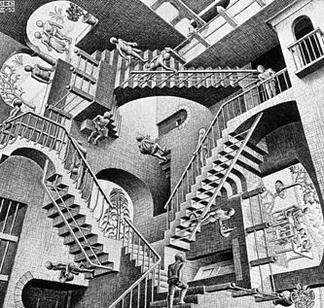
File:Escher's Relativity.jpg
Relativity, M.C. Escher, 1953

Artists play tricks all the time.  The works of M.C. Escher may be the most obvious examle of this.  But his deception is mathematical, and there for you to see—in a sense the job of the viewer is to try to figure out how he has done it.  Orson Welles was right to ask what’s in a man’s name, and right to point out that it may not matter that much.  But what does matter for something like the Faun and other forgeries is the lie told to the audience or the buyer.  Art forgers may be the creator of the work, but also those who attempt to pass off works they know or should know are forged on an unsuspecting public.

The bigger question is how many forgeries are exhibited in museums alongside the authentic works.  When buyers and sellers and museums are not careful about the history of an object (including antiquities) we might think of them as a kind of forger as well.  They may be unwitting, and fooled by a clever forger as the Art Institute of Chicago was, but when they value the object above everything, they risk becoming complicit in the forgery. 

  1. Martin Gayford, Art forgeries: does it matter if you can’t spot an original?, Telegraph.co.uk, June 17, 2010, http://www.telegraph.co.uk/culture/art/art-features/7824999/Art-forgeries-does-it-matter-if-you-cant-spot-an-original.html (last visited Jun 18, 2010).
Questions or Comments? Email me at derek.fincham@gmail.com

Stramignoni on Art and Law

Igor Stramignoni (London School of Economics – Law Department) has posted Seizing Truths: Art, Politics, Law on SSRN. This is a longer version of Stramignoni’s presentation at the Tate Modern in March. Here is the abstract:

    The work of French philosopher Alain Badiou has been described as the most powerful alternative yet conceived in France to the various forms of postmodernism that arose after the collapse of the Marxist project. Art interests Badiou in its own right but also as both that which, in the twentieth century, eclipsed philosophy and as that which today philosophy, increasingly de-sutured from art, must imitate in order to make clear that there are truths after all. Badiou conceives of law, on the other hand, as part and parcel of a specific political machine that must continuously perform certain problematic exclusions if it is to keep the fiction of parliamentary democracy together. So how is the relationship between art and law, between the poet and the city, in Badiou’s oeuvre?
Questions or Comments? Email me at derek.fincham@gmail.com

"International Law for Cultural Heritage" tomorrow in Florence

The European University Institute and the European Journal of International Law are holding a symposium tomorrow, June 18th in Florence.  I understand you may contact Anny Bremner (anny.bremner@eui.eu) to register.  Here is the program:

International Law for Cultural Heritage

European University Institute, Florence
Villa Schifanoia, Cappella
18 June 2010

Programme

9:15-9:30 Welcome Remarks by the Editor-in-Chief and Introduction to the Symposium by Francesco Francioni

9:30-10.45 PANEL 1: Indigenous Peoples’ Cultural Rights

Siegfried Wiessner, St. Thomas University School of Law, Miami, Florida
Karen Engle, University of Texas Law School
Gaetano Pentassuglia, Liverpool Law School, Fernand Braudel Fellow, European University Institute

10.45-11.15 Coffee Break

11.15-12.45 PANEL 2: Restitution of Cultural Objects and Human Rights

Ana Filipa Vrdoljak, University of Western Australia
Tullio Scovazzi, University of Milan
Thérèse O’Donnell, University of Strathclyde

12.45-14.00 Lunch

14.00-15.15 PANEL 3: Intangible Heritage

Lucas Lixinski, PhD Researcher, European University Institute
Federico Lenzerini, University of Siena

15.15-15.30 Coffee Break

15.30-16.45 PANEL 4: IHL–ICL and Cultural Heritage

Micaela Frulli, University of Florence, Marie Curie Fellow, European University Institute

16.45-17.00 Discussion and Closing Remarks by the Editor-in-Chief

Questions or Comments? Email me at derek.fincham@gmail.com

Indianapolis Museum of Art to Receive Loan of Roman Antiquities

An image of a Vigna Codini Columbarium

Some good news for Museums and nations of origin.  The Indianapolis Museum of Art has issued a press release to announce a loan of ancient sculptures from the Museo Nazionale Romano beginning in January 2011.  The loans are for a renewable two-year period and include three life-size portrait busts and a marble funerary urn from the Vigna Codini Columbarium, which the release describes as an important Roman tomb discovered in 1847.

Max Anderson of the IMA really nails the importance of these agreements when he states in the release that “American museums have few examples of ancient art which can be displayed with their complete context understood . . .  The Vigna Codini Tomb contents from the Julio-Claudian and Flavian periods open a window to understanding that only long-term loans can provide, since the inadequate ownership history is no longer acceptable.” This is what a licit antiquities trade could be.  We know where the objects originated, how they came to the museum; visitors will see the context; all in a “universal” museum. 

The release notes that these are the types of loans the Memorandum of Understanding between Italy and the United States was meant to promote.  Those interested in the MOU and the practical impact it has or has not had should look to the recent edited volume, Criminology and Archaeology (Simon Mackenzie and Penny Green, 2009). I review the volume in the Spring issue of the Journal of Art Crime. Of particular interest is Gordon Lobay’s contribution, which looks empirically at how the U.S.-Italy MOU has made an impact on the antiquities market—at least the observable licit market.

  1. Italy to Loan Roman Sculptures to the Indianapolis Museum of Art, IMA (2010), http://www.imamuseum.org/sites/default/files/VignaCodiniFinal.pdf.
Questions or Comments? Email me at derek.fincham@gmail.com

Senator Dodd Weighs in on Yale and Peru

Sen. Chris Dodd has weighed in on the dispute between Yale and Peru over objects removed by Hiram Bingham from Peru during the early part of the 20th century. Bingham brought widespread attention to Machu Picchu during a serious of expeditions, and he returned home with many objects, which have been in the possession of Yale, despite what Peru claims was an agreement to return those objects.  Yale has offered to provide material and financial support for research in Peru in exchange for a traveling exhibition and continued lease of the objects, however that agreement fell through and Peru has sought relief in federal Court.

Yet now Sen. Dodd has offered to intervene.  Though he says Peru are the rightful owners of these objects, he may mean these are items of cultural heritage which should be returned to Peru.  “The Machu Picchu artifacts do not belong to any government, to any institution, or to any university,” Dodd said in a statement. “They belong to the people of Peru. I plan to work with both parties to resolve this dispute quickly, amicably, and return the artifacts to their rightful owners.”

From the AP story:  “Machu Picchu has special significance for Peru and the entire world,” Yale said in a statement. “We look forward to a plan that preserves the artifacts and ensures their availability to the public and scholars to promote further appreciation and study of the rich cultural legacy of Machu Picchu.”

For background on this dispute, see these posts

  1. John Christoffersen, Senator Christopher Dodd Says Artifacts Held by Yale Belong to Peru, http://www.artdaily.org/index.asp?int_sec=2&int_new=38572 (last visited Jun 15, 2010).
  2. In Peru, Dodd Works to Mediate Dispute Over Machu Picchu Artifacts | U.S. Senator Christopher J. Dodd, (2010), http://dodd.senate.gov/?q=node/5658 (last visited Jun 15, 2010).
  3. Cultural Property Observer, Connecticut Senator Sides with Peru Against Yale Cultural Property Observer (2010), http://culturalpropertyobserver.blogspot.com/2010/06/connecticut-senator-sides-with-peru.html (last visited Jun 15, 2010).
Questions or Comments? Email me at derek.fincham@gmail.com