Discussion on the Need for Social and Cultural Theory

An exciting discussion is taking place this week at the University of Chicago Law School BlogBeyond Economic Analysis of Intellectual Property: The Need For Social and Cultural Theory?” many of the same issues that occur in the intersection between commerce and heritage in the antiquities or art trade also exist when other intellectual property is bought and sold or subjected to legal regulation. The conversation began with a post by Hadhavi Sunder, who makes some excellent arguments that Intellectual Property needs to move beyond its traditional economic justifications.

Over the course of the last century intellectual property has grown exponentially, but its march into all corners of our lives and to the most destitute corners of the world has paradoxically exposed the fragility of its economic foundations while amplifying its social and cultural effects. Today intellectual property laws bear considerably upon central features of human flourishing, from the developing world’s access to food, textbooks, and essential medicines, to the ability of citizens everywhere to democratically participate in political and cultural discourse.


Despite these real world changes, intellectual property scholars insist on explaining this field through the narrow lens of a particular economic vision.Intellectual property is understood solely as a tool to solve an economic “public goods” problem: nonrivalrous and nonexcludable goods such as music and scientific knowledge will be too easy to copy and share—thus wiping out any incentive to create them in the first place—without a monopoly right in the creations for a limited period of time.

These are some heady concepts, and I think these are some excellent ideas. I’ve tried to construct the argument elsewhere that in the context of antiquities we need to value the broader cultural value of antiquities in constructing and formulating heritage policy.

Other posts in the series this week include:


Questions or Comments? Email me at derek.fincham@gmail.com

More on the Dutch Recovery

Is stolen the same as sold?  David Charter for the Times has more details on the recovery of eight works stolen 22 years ago.  He reports that in December a middleman in Dubai tried to sell the works back to the insurance company. 

The detective, Ben Zuidema, [who was hired to investigate the theft two decades ago] said that he was contacted out of the blue by a man wanting to sell the paintings back to the insurers for €5 million (£4.5 million). Included in the offer was €1 million for Mr Zuidema to facilitate the deal.

 The good news is the works were recovered, however many were folded and badly damaged, including this work by Jan Brueghel the Younger. 

The story gets stranger with respect to a still-missing ninth work.  As the private detective Zuidema told Dutch reporters this still missing work may have been destroyed by the gallery owner Robert Noortman who died two years ago.  That is certainly a very serious accusation, and one which Noortman is no longer alive to defend against.  He is quoted by the Dutch news agency Algemeen Nederland Persbureau that “I shared my findings about him with the police in Maastricht, . . .  But in the end it did not lead to the finding of the paintings.”
At the time Noortman claimed that “Stolen is sold”.  True enough for the bottom line, though it is a pretty distasteful sentiment as these works were lost for 22 years, and have emerged very badly damaged.  

(photo credit:  Ruben Schipper/EPA)

Questions or Comments? Email me at derek.fincham@gmail.com

8 Works Recovered 22 Years After the Theft

On Saturday Dutch prosecutors said three people had been arrested in connection with a theft which took place in 1987 from the Noortman gallery in Maastricht.  In the statement Dutch prosecutors said “The suspects were apparently trying to sell the art works to the insurance company that had paid out 2.27 million euros (£2m) after they went missing . . .  The investigation has yet to determine where the paintings have been for more than 20 years,”

 The works were by 17th Century artists David Teniers, Willem van de Velde and Jan Brueghel the Younger, as well as 19th Century painters Eva Gonzales, Pierre-Auguste Renoir, Camille Pissarro and Paul Desire Trouillebert.

Questions or Comments? Email me at derek.fincham@gmail.com

It Takes a Thief to Install an Alarm

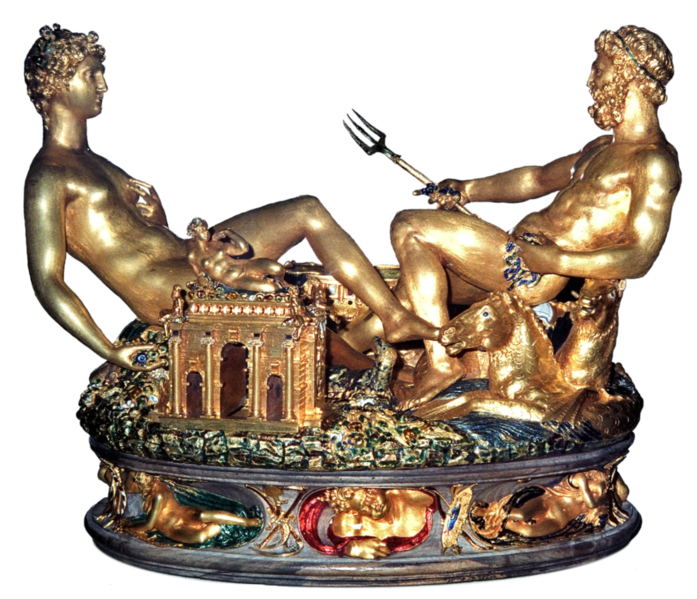
File:Saliera.pngThis is the Cellini Salt Cellar, an elaborate gold and enamel table decoration, measuring only 10 inches in height. It was stolen on May 11, 2003 from the Kunsthistorisches Museum in Vienna. It was later recovered in January 2006 near Zwettly, Austria. The thief, Robert Mang was an alarm-systems installer with no criminal history. The theft was listed at one time as one of the FBI’s Top Ten Art Crimes.

He claimed to have had a couple of beers before the theft. He climbed into the museum which was covered in scaffolding at the time, and took the work. After hiding it under his bed for a couple of years he attempted to ransom it back. He sent a number of ransom notes to the museum’s insurance company threatening to melt the work down if he wasn’t paid €10-million. Though eventually a photo of him was circulated and he was forced to turn himself in to the authorities

Mang turned himself in to the police, and served two years and nine months in prison. Now it seems he will return to selling and installing alarm systems: (via) “he had distributed advertising leaflets and made appointments to check on the state of installed alarm systems or to install new ones . . . his lawyer Lukas Kollmann said: ‘He wants to be left alone in order to lead a normal life again.’

Photo Credit: Herbert Pfarrhofer/European Pressphoto Agency

Questions or Comments? Email me at derek.fincham@gmail.com

On Paying Art Ransoms

In 1994, two works by JMW Turner in the Tate collection:   
Shade & Darkness – the Evening of the Deluge (Shade & Darkness)File:William Turner - Shade and Darkness - the Evening of the Deluge.JPG

and Light & Colour (Goethe’s theory) – the Morning after the Deluge – Moses Writing the Book of Genesis (Light & Colour), 1843: 

File:William Turner, Light and Colour (Goethe's Theory).JPG

were stolen from the schirn Kunsthalle in Frankfurt during a loan exhibition. Late last week the Telegraph had an interesting piece on the role of Lord Myners and a £3.1 million pound ransom which was paid to a German lawyer acting as a middleman for the thieves. 

Mr Daley challenged Lord Myners over the ransom money after another Tate director admitted in a television documentary that a fee had been paid.


Lord Myners claimed he had been “given an undertaking” by the executives of the Tate that no ransom had been paid.


Mr Daley said: “Lord Myners told me the money had been paid as part of a sting operation by German police, but Sir Nicholas Serota, the director of the Tate, had stated quite clearly in court that the German lawyer was in touch with the people who had the paintings and they were prepared to hand them over in return for payment.

The piece seems more focused on Myners’ role in another controversy with the pension fund at the Royal Bank of Scotland.  The interesting point I think is that the High Court, in a closed hearing, made a determination that the trustees of the Tate actually had a legal obligation to pay the ransom.  From the Tate’s own press release in 2005:

Tate applied to the High Court for final authority to enter into the transaction. The hearing was held ‘in camera’ in order not to prejudice ongoing operations. The Trustees of Tate, as the Court acknowledged when authorising the payments by Tate, were under a legal obligation to preserve and recover trust property. Accordingly, subject to the recovery being legal (as the Court ruled it was) and the risks of the operation being proportionate, Tate’s Trustees were under a positive legal obligation to enter this transaction.

Tate made payments to Edgar Liebrucks and was responsible for the expenses of those helping in the investigation. It was acknowledged by the Court, and Tate, that the payments to be made by Tate to Edgar Liebrucks might well be passed on to others, including those holding the paintings. However, once Tate had paid the money to Edgar Liebrucks, it had no control over that money. Tate does not know to whom Mr Liebrucks made payment of the monies he had received from Tate. The relationship between Edgar Liebrucks and his contacts was a matter for the German authorities and regulators to pursue, not Tate.

Though the ransom had the blessing of the high court, it may not have been a sound one for the security of museum collections generally.  Mark Durney at Art Theft Central highlights the piece and speculates on ransoms and art theft generally.  He first summarizes the work of criminologist Simon Mackenzie:

The “flag effect” argues that certain types of properties that have been stolen from in the past stand out as more attractive targets to thieves. In “Criminal and Victim Profiles in Art Theft: Motive, Opportunity and Repeat Victimisation,” in Art Antiquity and Law 2005, Mackenzie cites for an example of the “flag effect” the rash of thefts across Canada inspired by the prospect of a reward after a ransom was paid for the return of six painting stolen from the Toronto Art Gallery in 1959 (10). After the Toronto art theft, “flags” were placed on galleries and museum by virtue of their poor security. 

He goes on:

In the case of the Tate and its Turners, at the time the museum claimed to have kept quiet on the amounts paid for the stolen Turners “in order not to jeopardise the operation.” Also, Lord Myners maintains that the payments were made to informants, and were not ransoms. However, Friday’s article reiterates that the payments, according to the director of the Tate, were made to a German lawyer acting as middleman for the thieves.

Over at Art Knows Tom Flynn argues:

The Tate commented that the most important objective in the Turner negotiations was the recovery of the works of art. What about ethics? The fact that by paying a recovery fee the Tate might have sent out the wrong message to other criminals seems to have been ignored, along with the fact that art theft often involves violence.

Paying ransoms is generally a very bad idea.  It provides a revenue stream for the art thieves, and its one of the only revenue streams if the work is particularly well-known.  Even if an object is sacred, and beautiful and irreplaceable—it is still probably better to risk its destruction or mutilation rather than encourage other thefts. 

Questions or Comments? Email me at derek.fincham@gmail.com

Not Paying for the Bronzes

I’m catching up on all of the reactions to the decision by Cai Mingchao, the general manager of Xiamen Harmony Art International Auction Co. and the winning bidder on the two Chinese bronzes which were recently sold at Christie’s Yves St. Laurent auction in France.  Art Observed does a great job collecting many of the reactions which appeared in the press.

Tom Flynn asks the right question I think, “Are we entering an era of guerilla activism, where sabotage of art auctions becomes another weapon in cultural heritage repatriation disputes?”

I think Christie’s is scrambling along with other major auction houses to make sure something similar cannot or will not happen again.  Mingchao is of course subject to civil penalties under French law, perhaps even criminal as well.  If Christie’s pushes that approach, they may risk a difficult public relations battle, as Mingchao has quickly become a sort of national hero in China.  But it is hard to see how they can just do noting.  If one bidder can disrupt the process in this way, all a nation of origin needs to do is enlist a wealthy or sympathetic bidder to disrupt the process of any future object which might be similarly sensitive. 

I think it is another indication of the increasing role that nations of origin are playing in the heritage marketplace.  I’m not sure how many wealthy bidders would be willing to stake their reputation or future ability to bid on such a move in the future, but this was a cunningly simple, very shrewd strategic move by Mingchao and the Chinese.  They wanted to disrupt the market in these objects which had been looted, and did a brilliant job doing so. 

From AlJazeera English:


Questions or Comments? Email me at derek.fincham@gmail.com

My Work in Progress on Increased Scrutiny of Good Faith

I’ve posted on SSRN a work in progress, Fraud on Our Heritage: Towards a Rigorous Standard for the Good Faith Acquisition of Antiquities. I attempt to make a case for heightened standards for good faith, particularly in the context of museums and antiquities. I would be delighted to hear any thoughts/reactions to the piece. Here is the abstract:

If a family of art forgers living in modest public housing in Bolton, England can easily fool some of the World’s leading cultural institutions, then surely the current state of the antiquities market must be badly broken. Ideally a diligent enquiry before a purchase confers good faith status, allows purchasers to acquire good title, and gives the legal right to seek compensation from an unscrupulous seller. Despite these important advantages, good faith has been used merely to promote commercial convenience and economic efficiency. This article proposes a new theoretical foundation for increased scrutiny of the antiquities trade by constructing a broad basis for the recognition of good faith as a mechanism for eliminating the illicit trade in antiquities.

Though an existing body of law prohibits and punishes a variety of activities which further the illicit trade, these measures are severely hampered by the mystery surrounding antiquities transactions. With increased scrutiny and a more rigorous and diligent analysis, these legal measures will become far more effective. At present, details regarding authenticity, title, or even more basic questions such as the origin of an object are intentionally hidden and disguised from public view. When an object is acquired without a rigorous due diligence process, that acquisition defrauds our heritage by distorting the archaeological record; harms the legitimate acquisition of antiquities; perverts the important role museums play in society; and ultimately warps the understanding of our common cultural heritage.

Consequently, this article proposes a theoretical underpinning for a new and rigorous standard for the acquisition of art and antiquities. In so doing, it develops a theory which can successfully navigate the secrecy surrounding the trade and acquisition of antiquities. It concludes by offering a critique of the recent attempts by law and economics scholars to analyze the antiquities trade and concludes that they may offer some useful policy models so long as they account for the preservation of heritage and context in their “efficiency” models.

Questions or Comments? Email me at derek.fincham@gmail.com

Student Comment on American Cultural Heritage Law

Katherine D. Vitale has posted on SSRN her Student Comment, The War on Antiquities: United States Law and Foreign Cultural Property, 84 Notre Dame L. R. 101 (2009). 

She criticizes the general trend of American cultural heritage policy, and is far too kind I think to museums and antiquities dealers generally.  She has some very interesting things to say about the AAMD Guidelines, and does a very good job putting the recent California searches in context, perhaps helping to explain why a year has elapsed with little apparent progress.  

From the Abstract:

The use of the National Stolen Property Act and Archaeological Resources Protection Act as mechanisms to protect cultural property taken from a foreign state through prosecution of individuals who buy, sell, and otherwise deal in such property is in direct tension with the Convention on Cultural Property Implementation Act (“CPIA”), a statute enacted in accordance with an international treaty to which the United States is a party. This Note explores how criminal liability under United States law for museum officials and others who acquire art, archaeological materials, and especially antiquities, originating in foreign nations conflicts with CPIA’s treatment of foreign cultural property. Part I discusses the principle of protection of cultural property in international law and the manifestation of this principle in the United Nations Educational, Scientific and Cultural Organization’s 1970 Convention on the Means of Prohibiting and Preventing the Illicit Import, Export and Transfer of Ownership of Cultural Property (“1970 UNESCO Convention”). Part II examines the 1970 UNESCO Convention’s influence on United States civil law and policy regarding foreign cultural property, and on the acquisitions policies of international and domestic museums. Part III discusses criminal penalties under both the National Stolen Property Act and the Archaeological Resources Protection Act for those who knowingly acquire stolen foreign cultural property. Part IV analyzes the conflict between policies on foreign cultural property followed by the United States and domestic museums and the application of criminal penalties in art-trafficking cases. In addition, this Part explores the consequences of the conflict for both the United States and individuals, and suggests resolutions to the conflict through law. Finally, Part V concludes that in order for the United States to fulfill its obligation under the 1970 UNESCO Convention, it must stop conducting a war on antiquities-and those who acquire them.

Questions or Comments? Email me at derek.fincham@gmail.com

"The sea is a vast museum of shipwrecks"

So says Texas A&M University’s Prof. Shelley Wachsmann in a very good ABC (Australia) piece on the dangers facing underwater heritage sites in Greece, and a new Greek law which may open Greece’s coastline to increased diving.

 
Greece’s 1932 antiquities law says all artefacts on land and in the sea belong to the state, but it does not regulate scuba diving, . . .
A new law implemented in 2007 and designed to promote tourism opens most of Greece’s 15,000km coastline to scuba divers, except for about 100 known archaeological sites.
Greece’s archaeologists’ union and two ecological societies have appealed for the law to be rescinded.
Meanwhile, some tour companies are luring tourists with the promise of ancient artefacts.
“Scuba diving in Greece is permitted everywhere … Ideal for today’s treasure hunter,” says the website www.scuba-greece.com.
The director of antiquities at the Culture Ministry, Katerina Dellaporta, says metal detectors and bathyspheres allow treasure hunters to find artefacts with ease in the Adriatic and Aegean.
“It’s good to have tourism, but we must protect antiquities,” she said.
“Not every diver is an illegal trafficker… but we need to ensure these treasures remain for future generations.” . . . 

Most of the world-famous bronzes in Greece’s National Archaeological Museum, such as the 5th-century BC statue of Poseidon hurling his trident found off Cape Artemision, were salvaged from the sea.
Statues on land tended to be destroyed or melted down for coins or weapons.

Some were found in shallow-water shipwrecks like the one off Antikythera, believed to be a 1st century BC Roman ship carrying a haul of ancient Greek art back to Italy.

Other precious statues were dredged from the deep ocean in fishermen’s nets.
Greece offers handsome rewards to prevent relics falling into private hands.
It paid 440,000 euros ($872,000) to a fisherman for a female torso off the island of Kalymnos in 2005.
Questions or Comments? Email me at derek.fincham@gmail.com

French judge Denies China’s Claim for Summer Palace Bronzes

A french judge on Monday denied China’s claims for these two bronze objects, looted from the Old Summer Palace in Beijing in 1860, to be auctioned at the Yve Saint Laurent auction tonight in Paris.  They had been transferred a number of times during the 20th century, and the alleged wrongdoing took place nearly 150 years ago.  If China wants the objects back they have only two options.

First, as Pierre Berge, Saint Laurent’s partner, offered earlier “The only thing I ask is for China to give human rights, liberty to Tibet and to welcome the Dalai Lama.”

Or second,  they could purchase the objects at the auction.  As Barbara Demick’s piece in the L.A. Times notes:

An entire museum in Beijing run by the Poly Corp., which is operated by a state-owned military enterprise, is filled with repatriated artworks, including several other bronze animal heads that along with the two held by Saint Laurent were part of the set of 12 representing the signs of the Chinese zodiac.

The museum bought the tiger, monkey and ox through auction houses in Hong Kong in 2000, while the pig’s head was recovered in New York by Hong Kong casino magnate Stanley Ho, who in turn donated it to the museum.

But the Chinese are increasingly resentful at the high prices they’ve had to fork out. Ho reportedly paid $9 million in a deal brokered by Sotheby’s to get the horse head back from Taiwan. Christie’s was reported to be asking $10 million each for the rabbit and rat in behind-the-scenes negotiations in the last few years with prospective Chinese buyers.

“It is really shameful. They are like kidnappers demanding ransom to give back your own child,” said Li Xingfeng, one of a group of 81 Chinese lawyers who filed the lawsuit last week in Paris trying to block the sale. They have vowed to pursue the case to recover the heads from whomever might buy them.

Questions or Comments? Email me at derek.fincham@gmail.com