There has been an upswing in the use of corporate funds to preserve and rehabilitate some of the World’s great cultural heritage sites in Italy. Gaia Piangiani and Jim Yardley report for the New York Times:
While private-public partnerships are common in the United States and many other countries, the government has traditionally been responsible for maintaining historical sites in Italy, and even today some historians and preservationists worry that the shift could lead to crass commercialization. Critics complain that companies have exploited cultural sites by commandeering them for elaborate dinners or the display of luxury advertisements.
Indignation ran high in Florence after it was discovered that city officials had allowed Morgan Stanley to hold a dinner inside a 14th-century chapel for a rental price of $27,000. Florence’s mayor doubled the rent to $54,000 after the outcry, but some argued that price was not the core issue.
“There are sacred places where one can simply not hold a dinner,” said Salvatore Settis, an expert in cultural heritage law and a former director of the J. Paul Getty Research Institute in Los Angeles. “Not even for four million euros” ($5.4 million).
Many preservationists were also outraged that Rome’s mayor allowed the Rolling Stones to rent Circus Maximus for an outdoor concert last month.
Prime Minister Matteo Renzi has often spoken about the need to enlist private companies to underwrite work at sites like Pompeii, where more than $137 million in European Union funds has already been spent. In May Mr. Franceschini, the culture minister, announced a new tax deduction intended to encourage private-sector donations for the restoration and preservation of museums, archives, libraries and theaters.
To many other nations this kind of corporate assistance seems relatively benign. So long as the sites receive much-needed care, there seems to be little potential harm. The Mausoleum of Augustus, right around the corner from the Ara Pacis in Rome, is badly in need of some attention, and may it with a donation from a Saudi Prince.
NPR yesterday featured an interview with Christopher Dickey, foreign editor for the Daily Beast, discussing the risks posed to antiquities in Mosul:
Well, what’s at risk are some beautiful monumental sculptures, these winged figures, lions and bulls, with the faces of bearded men – Kings, that clearly were idols in the time of the Assyrians. But that are now part and parcel of the history of Western civilization and biblical history especially. And then we’ve also got gorgeous gold jewelry which certainly will go onto the black market and all kinds of smaller pieces of sculpture, earthenware, the kinds of things that give you the texture as well as the beauty of life in that period. So it’s a rich museum but all of that collection is now in the hands of ISIS.
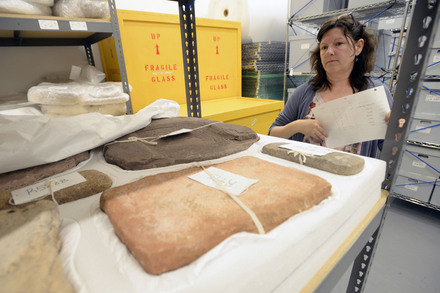
These grinding stones had been used by some defendants to line their driveways
The Salt Lake Tribune follows up on the status of the objects seized during the four-corners antiquities operation. The Federal government seized some 6,000 allegedly-looted antiquities, but has no clear victim or community to return them to in most cases.
The Salt Lake Tribune has video of a curator for the Bureau of Land Management supervising the warehouse where these objects are located. She shows the corn grinding stones which were removed from their context and had been used by some of the defendants to line their driveways.
Changing the attitudes in these communities is a crucial step to reducing the looting. And Federal officials are primarily seizing the material, without it seems the benefit of any broader education initiatives or criminal sanctions:
In Blanding and surrounding counties, residents once openly gathered artifacts and such collecting was considered a legitimate family activity. The laws changed in the 1970s, criminalizing the removal of artifacts from tribal and federal land.
But looting persisted, to the dismay of archaeologists and American Indians. Graves were a favorite target because they tend to yield intact objects buried with the dead.
The point of the “Operation Cerberus” investigation was not to jail looters, BLM officials said, but to rein in the illegal antiquities trade.
“You can’t put [an artifact] back, but it is forever out of the black market. This effort was to start unraveling it where it started,” said Smith, an archaeologist who served as BLM’s Canyon Country district manager at the time of the 2009 raids.
Will simply securing objects, without seeking to prosecute and jail individuals be an effective criminal response? It remains to be seen, but indications from the communities themselves seems to suggest that the local communities have not embraced the Federal government’s position.
CNN image of the destruction of the Buddha at Bamiyan in 2001
There has been a renewed series of reports in recent weeks connecting the looting of antiquities to terrorism. This recent Guardian article quotes an unnamed intelligence official stating that ISIS (Islamic State in Iraq and the Levant) has partially funded its activities through looting antiquities from ancient sites, though it surely gained far more by commandeering oilfields. Also this piece by Heather Pringle for National Geographic does a good job profiling the work of the Trafficking Culture group at the University of Glasgow, but it cannot resist the big headline. The Nat. Geo. piece makes mention of some of the tenuous connections between insurgents, terrorists, and antiquities looters. I’m uncomfortable calling every insurgent a terrorist, and the connections which are made point to antiquities looting as being a very minor, if inconsequential aspect of the activities of these groups. Matthew Bogdanos, the Marine and prosecutor, has also publicly stated that terrorists loot as well though I’m not aware of specifics he can point to.
The root for these connections may be this 2005 Der Spiegel article which again cites an unnamed investigator, this time a member of Germany’s BKA, as claiming that Mohammed Atta may have tried to use looted antiquities to finance the 9/11 terrorist attacks. This report, which contains little concrete information has had a longer shelf-life than it deserves, and has been used by a number of less-rigorous researchers, notably this piece authored by Noah Charney and two others which appears on the FBI website and breathlessly exclaims “[f]undamentalist terrorist groups rely on looted antiquities as a major funding source”. The data simply is not there to make this kind of connection, no matter how many clicks, headlines, or book sales it might generate. And making the connection is unhelpful.
What’s the harm in connecting antiquities looting to the activities of terrorists, ISIS, and other unsavory groups? For one, it diminishes the importance of antiquities looting as an issue. These reporters and some in law enforcement make the claim because many politicians and officials who make decisions about prosecutions and allocation of resources do not make policing antiquities a priority. As many have pointed out, too many law enforcement agencies still treat art theft and looting of sites as a property crime. The efforts to connect antiquities looting to terrorism then is a way to bootstrap this issue on to other crimes which receive more attention. Chasing the looting/terror connection means that some heritage advocates can even attempt to lump collectors and museums into funding terror. This is an unfortunate trend, and one which I think does the heritage community a disservice and lessens the level of intelligent discourse. Imagine a terrorist network is apprehended and we know it received funding by looting sites. If the network is “dismantled” by prosecution or drone strike, the site is still there, still unprotected, and still not a priority.
I suspect many terrorist and insurgent groups probably do engage in antiquities looting to some extent. But they engage in lots of other more lucrative criminal activity too. Just because hijackers may have visited strip clubs, played video games, or taken flying lessons does not make those activities “terrorism”. They are correlations without meaningful connections. Terrorists are the worst kind of criminal, and should be pursued and prosecuted as such. Likewise, archaeological looting is a serious and tragic crime which robs us of our collective cultural heritage. To attempt to make cheap connections between looting and terrorism undermines the cause and seriousness of the theft and looting. There are far more direct links between armed conflict and the looting and destruction of sites, we should perhaps focus our energy there. If we want our politicians and law enforcement agencies to take heritage crime seriously, we need to work harder to make them pay attention with real facts, losses, and data and avoid chasing tenuous links which are dramatic but have little chance of producing sound long-term cultural policy. The links may exist, but those interested in preserving antiquities should dial back linking the looting of sites with terrorism.
Qualitative empirical studies of the illicit antiquities trade have tended to focus either on the supply end, through interviews with looters, or on the demand end, through interviews with dealers, museums and collectors. Trafficking of artefacts across borders from source to market has until now been something of an evidential black hole. Here, we present the first empirical study of a statue trafficking network, using oral history interviews conducted during ethnographic criminology fieldwork in Cambodia and Thailand. The data begin to answer many of the pressing but unresolved questions in academic studies of this particular criminal market, such as whether organized crime is involved in antiquities looting and trafficking (yes), whether the traffic in looted artefacts overlaps with the insertion of fakes into the market (yes) and how many stages there are between looting at source and the placing of objects for public sale in internationally respected venues (surprisingly few).
We are off for a few weeks for some summer teaching in Istanbul, some art-viewing in Amsterdam, and some other events. There will be lots to share here when I’m back in front of a keyboard, but posting will be light for a few weeks. In the meantime check out my blogging colleagues in the blogroll on the right for updates and commentary.
Attorney Nicholas O’Donnell rightly skewers the FBI’s recent media blitz on the so-called “confirmed sightings” of works stolen from the Gardner Museum:
If my skepticism sounds familiar, it is because there was a similar episode last year, when the FBI claimed “with a high degree of confidence” that it knew who had stolen the paintings. That story, as has often been the case, was released around the anniversary of the theft (though without mentioned that coincidence). Richard DesLauriers, the Special Agent in Charge in Boston, said then: “The FBI believes with a high degree of confidence that in the years after the theft, the art was transported to Connecticut and the Philadelphia region, and some of the art was taken to Philadelphia, where it was offered for sale by those responsible for the theft,”
The FBI theory seems to be this: an informant in a Dorchester garage accused Merlino of being involved, and someone else in the same garage knew Gentile, who had some police paraphernalia in his house. Really? Put that way, it is pretty clear why the FBI has not arrested anyone or offered more information: it cannot prove any of this.
The FBI said a year ago that it knew who was responsible, but clearly does not want to accuse Gentile directly. Instead, it is essentially asking the public to connect the fact that Gentile has some relation to Philadelphia, to the uncorroborated offers for sale in an “I’m just saying” sort of way.
The Gardner heist is a civic tragedy in here in Boston. It struck at one of our most treasured institutions. I can still picture the full-page headline in the Boston Globe the day that it happened (the Art Law Report was just a gleam in the eye of a local high school student then). But these recycled stories are not advancing the ball. If the FBI thinks it has a case against a responsible person, it should move on that information. If it is simply going to make insinuations, it should stop.
Gerald Fitzgerald argues that we need to increase the level of due diligence in the art market:
I propose a levy of 1% or less on the sale or auction of any artwork above a certain value—say, $5,000—earmarked fully for the creation and support of a Center for Provenance Research. Questions of inadequate provenance would be submitted to CPR review prior to further sale. This independent, nonprofit research center would apply acknowledged standards using instant accessibility to an electronic database uniting all relevant sources. A staggering, global collection is housed at the Family Library in Salt Lake City, UT, which is now digitizing genealogical records in more than 45 countries. In March 2014, the Vatican announced that it will begin to digitize 1.5 million pages of its manuscript collection of more than 41 million pages, a project it has outsourced to the Japanese technology group NTT Data. Other fields—medicine, music, and so on—are being accessed instantly, electronically; every major museum has its libraries being digitized.
No one has done so for provenance research. Overseen by a board of directors drawn internationally from museums, auction houses, dealers, and collectors, the CPR could be a recognized standard for due diligence now missing entirely. I estimate that it would take about 10 years to devise, fund, and implement the CPR. The levy ought to begin immediately following market commitment to the project, allowing funds to accrue throughout the planning and development stages. The need for a global CPR is underscored by the major auction houses continuing expansion into emerging markets, such as those of China and India.
I agree that diligence needs to be increased, and this seems like a very good idea to get it started.
A new project announced in Austin a few weeks back uses declassified satellite images has revealed as many as 10,000 new archaeological sites in the Middle East:
[T]he new Corona Atlas of the Middle East, unveiled Thursday at the Society for American Archaeology’s annual meeting, moves spy-satellite science to a new level. Surveying land from Egypt to Iran—and encompassing the Fertile Crescent, the renowned cradle of civilization and location of some of humanity’s earliest cities—the atlas reveals numerous sites that had been lost to history.
“Some of these sites are gigantic, and they were completely unknown,” says atlas-team archaeologist Jesse Casana of the University of Arkansas, who presented the results. “We can see all kinds of things—ancient roads and canals. The images provide a very comprehensive picture.”
The team had started with a list of roughly 4,500 known archaeological sites across the Middle East, says Casana. The spy-satellite images revealed another 10,000 that had previously been unknown.
The largest sites, in Syria and Turkey, are most likely Bronze Age cities, he says, and include ruined walls and citadels. Two of them cover more than 123 acres (50 hectares). (See also: “Drought Led to the Collapse of Civilizations.“)
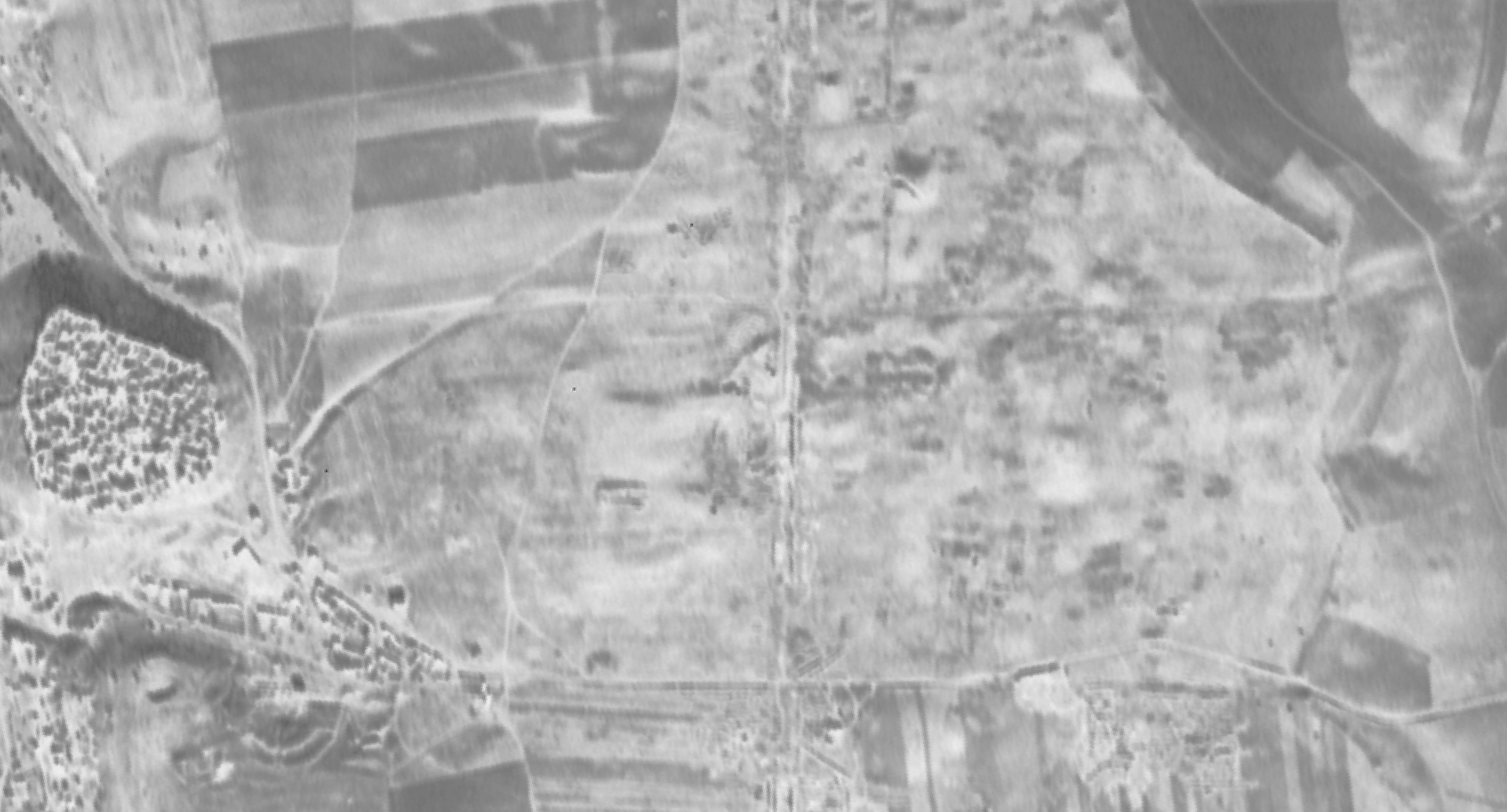
This sounds like a wonderful use of technology, offering some extremely useful comparisons with respect to climate change, migration patterns, etc. But for the illicit heritage trade, this offers a mixed set of challenges and opportunities. Looters have another tool (if they needed one) to find sites. But it also allows an opportunity for nations to harden these sites. The comparison of Apamea today to the satellite image of the same site in the late 1960’s is troubling:
Google image of Apamea
The level of detail in the newer image is stark, but there don’t appear to be the mass-looting pockmarks. What do you all think, does increased technology assist hardening of these sites, or provide a map for looters?
Bronze Statue of a Victorious youth, at the Getty Villa
Mike Boehm of the L.A. Times reports on the current status of the Fano Athlete/Getty Bronze dispute. A division of Italy’s High Court (Corta Suprema di Cassazione) is expected to weigh an appeal of an earlier forfeiture order this week. I’m quoted as the lone dissenting voice arguing the Bronze should be returned to Italy. I think a return is the just thing to do when you consider the violations of Italian patrimony laws which occurred when the Bronze was smuggled ashore, hidden in violation of Italian law, and then allegedly treated very badly before being smuggled to Brazil, then conserved in Europe before the Getty acquisition.
For a full discussion of my understanding of the history of the case and the reasons why I think Italy stands a good chance of having the Bronze returned soon, you can have a look at my forthcoming piece in volume 32 of the Cardozo Arts and Entertainment Law Journal.
Both Stephen Urice and Patty Gerstenblith seem to see the case differently:
“I’m baffled by this,” said Stephen Urice, a professor at the University of Miami School of Law who’s an expert on art law and cultural property law. “Even if you apply our ethical norms today, I don’t see a problem.”
Patty Gerstenblith, a leading advocate of protecting archaeological sites and sending looted art back to nations of origin, said that “Victorious Youth” shouldn’t be considered a looted work and needn’t be returned. Italy never had a legally valid ownership claim, she said, because the statue wasn’t found in Italian waters or on Italian soil, and it wasn’t made or owned by modern Italy’s Roman and Etruscan forebears.
Gerstenblith, a professor at DePaul University in Chicago and director of its Center for Art, Museum and Cultural Heritage Law, said the fishermen who netted the statue did break Italian laws by hiding their find instead of reporting it to authorities. So did the original buyers who shipped “Victorious Youth” out of Italy without a proper export permit.
Although those illegalities raise ethical questions that might make a museum in 2014 steer clear of a purchase, Gerstenblith said, they have no bearing on the fishermen’s right to have owned and sold the bronze statue, or the Getty’s right to keep what it bought.
In any case, the forfeiture effort is persistent, and the Italian authorities seem inclined to use every tool at their disposal to help secure a return, including cultural diplomacy, mutual assistance treaties, and domestic Italian court proceedings.